Islamic History
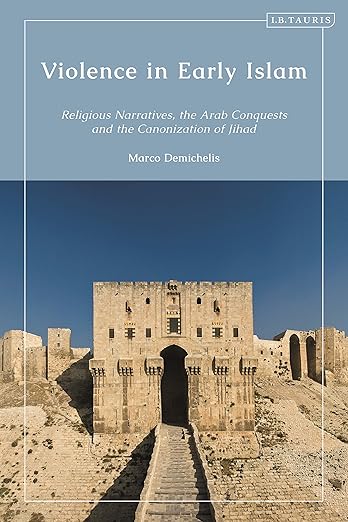
Violence in Early Islam
Religious Narratives, the Arab conquests and the Canonization of Jihad
Author(s): Marco Demichelis
Reviewed by: Anis Ahmad
Review
Reviewed by: Anis Ahmad – Riphah International University, Pakistan
Published by: I.B. Tauris, London, New York, 2022, 254pp. ISBN: 978-0755638031.
In the last two decades at least jihad has been equated to violence, terrorism, militancy and the use of brutal force for the implementation of the Sharia by the so-called Taliban or other claimants of a global Islamic state.
The book under review looks at these – and other similar – popular views rather critically through the prism of comparative historical narratives, the Qur’ān, Ḥadīth and the opinions of early Muslims thinkers who wrote on jihad. The author has an edge on many other orientalists and western writers who do not delve into original Islamic sources and depend instead on a selective group of authors, mainly later historians and jurists. And while trying to determine the secret behind the unusually swift conquests led by the Muslims in the eighth century, the author talks about the role of the conceptualisation of jihad. A common reason given by western writers like R. Hayland (In God’s Path) is the nomadic nature of the Muslim armies, which was similar to the nomadic force of the Mongols of Genghis Khan, the Turk Mongol herds of Timur and others.
The assumption that Islam spread through aggressive conquering campaigns, i.e. through the sword, and that the Qur’ān is a violent revelation can be seen in a wide range of western writings. The same authors, however, fail to read in the Qur’ān those passages that insist on the high value of human life and life itself. The Qur’ān frequently refers to the praiseworthy attributes of kindness, mercy, love, compassion, and rejects the unnecessary use of force. Any objective study of the Qur’ān will convince one about its major focus on ethical, moral and humanitarian