BOOK REVIEWS
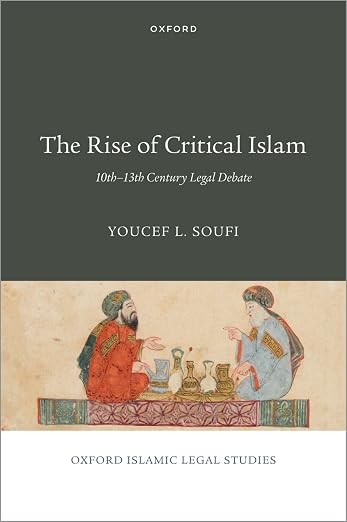
The Rise of Critical Islam
10th–13th Century Legal Debate
Author(s): Youcef L. Soufi
Reviewed by: Muhammad Yaseen Gada
Review
In The Rise of Critical Islam, Youcef L. Soufi attempts to dispel the modern stereotype that Islamic legal tradition is inherently antithetical to critical examination and intellectual freedom. (p.2) Investigating Sunni Muslim jurists from the 10th to 13th centuries, Soufi uncovers a vibrant “culture of critique” prevalent in Islamic legal discourse. The book is organized in three parts, divided into seven chapters, apart from an “introduction” in which the author builds a foundational framework for the book.
Central to this ethos was munāẓarah (debate/disputation/dialectic)—a process Soufi describes as “thorough, detailed, and ruthless” yet anchored in “decorum and mutual respect.” (p.5) Rather than aiming for mere polemical victory, munāẓarah operated on a shared commitment to uncover the objective truth of God’s law. Soufi explores this through the prolific Persian Shāfiʿī jurist al-Shīrāzī (d.1083), a “lion of disputation” (p.7) whose four surviving transcripts form the core of the book’s analysis. (p.12) These chapters dissect rigorous inter- and intra-school (madhhab) disputations held with contemporaries like al-Dāmaghānī (d.1085), a Ḥanafī jurist, and al-Juwaynī (d. 1085), a Shāfiʿī authority. (p.12)