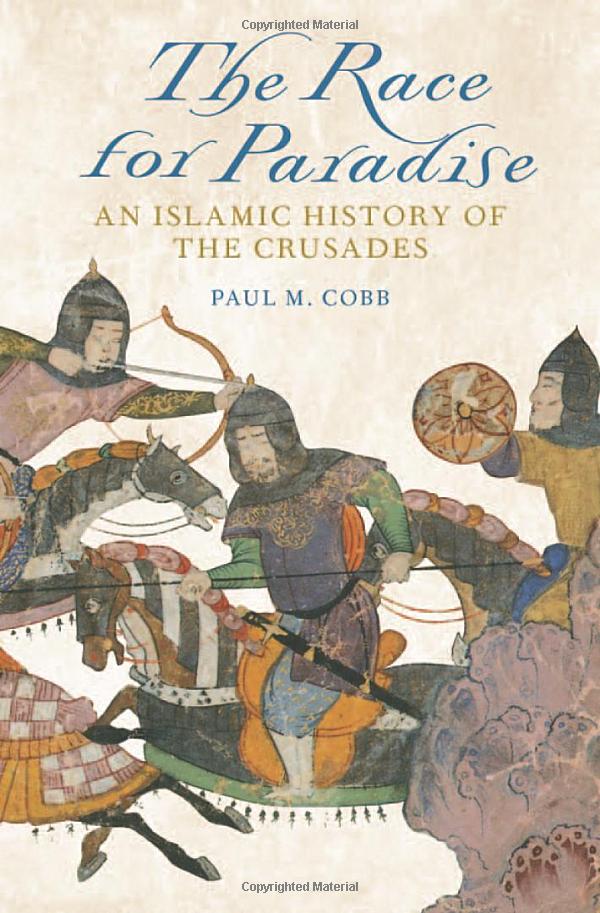
Islamic History
The Race for Paradise
An Islamic History of the Crusades
Author(s): Paul M. Cobb
Reviewed by: Muhammad Yaseen Gada
Review
Based primarily on original Islamic sources, Paul M. Cobb, Professor of Islamic History at the University of Pennsylvania, aims to show how the Crusades were perceived by the medieval Muslims themselves. (p. 6) The book consists of nine chapters, a prologue and an epilogue. The prologue, entitled “Damascus Crossroads”, opens with a description of the gallant personality of Salah al-Din al-Ayyubi, admired in the West as Saladin, the conqueror of Muslim Jerusalem. Cobb writes that the Crusades “can and should be understood in the context of the Islamic world” because the Crusades represent an “integral part of the history of Islamic civilization itself”. (pp. 7-8) For a balanced perspective, it is imperative to delve deep into the Islamic sources. The first chapter, “The Abode of Islam”, provides a brief history of Islamic civilization so as to offer a theoretical framework, as well as recounting the Muslim perception of medieval Christian Europe. The author states that: “to medieval Muslim eyes, Western Europe was superficially impoverished; one might even say a ‘developing’ region on the margins of the world”. (p. 19) Moreover, while comparing Jihad with the Crusades, , Cobb interestingly asserts that Jihad “is not militarism, to be contrasted with pacifism, but rather war with a pious intent to be contrasted with the vast taxonomies of war that are secular”. (p. 30) He further argues that the “goal of Jihad was the conversion of infidels to Islam”. (p. 29) If that had been the case, there would not be any non-Muslims in those parts of the world that the Muslims had conquered. Rather the goal of Jihad is the spreading of justice on Earth.