Islamic History
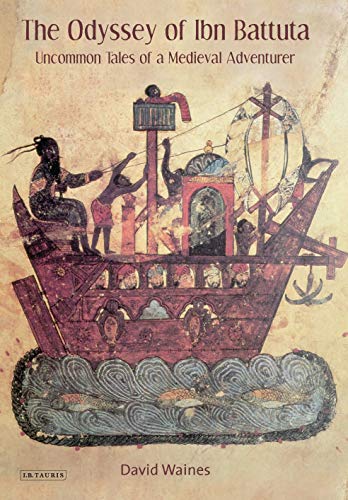
The Odyssey of Ibn Battuta
Uncommon Tales of a Medieval Adventurer
Author(s): David Waines
Reviewed by: Mohammad Seddon, University of Chester
Review
In modern times Muslim identity and religious fidelity have been proscribed by an ever-increasingly narrow scriptural literalism and unfounded claims regarding accultural forms of ‘Muslimness’. Hence, the many diverse, syncretic and geo-cultural manifestations of Islam have been frowned upon as both innovations (bid[ah) and religious laxity (dalalah). In an age where Muslim self-consciousness has been heavily informed by the classical theological texts of rationalist scholars such as Ibn Taymiyyah and Ibn Kathir, it is refreshing to be reminded of how the real world of medieval Islam was best captured by early Muslim ‘ethnographers’ like Ibn Khaldun and Ibn Battutah.
Whilst Ibn Khaldun was one of the first scholars to explore the sociological dichotomies of urban and rural Arab-Islamic societies, his contemporary, Ibn Battutah, often wrongly referred to as ‘the Arab Marco Polo’, produced his eponymous, al-Ritilah (‘The Travels’). In so doing, Ibn Battutah earned himself the place of one of the world’s most prolific travellers, journeying throughout the then known Muslim world and beyond in an epic journey stretching across continents and punctuated with tales of adventure, fortune and exotic encounters. His travelogue has proved a timeless tale that has been the subject of countless research studies and translated works since its original recounting by Ibn Juzayy circa 1365 CE. The odyssey’s enduring appeal is undoubtedly the journeyman’s somewhat unbelievable tale, not just in the phenomenal distances he claims to have covered but also in his almost never-ending turn of fortune and incredible experiences. The backdrop to Ibn Battutah’s adventures is the disparate and varied peoples and cultures he encounters along the way.