Islamic History
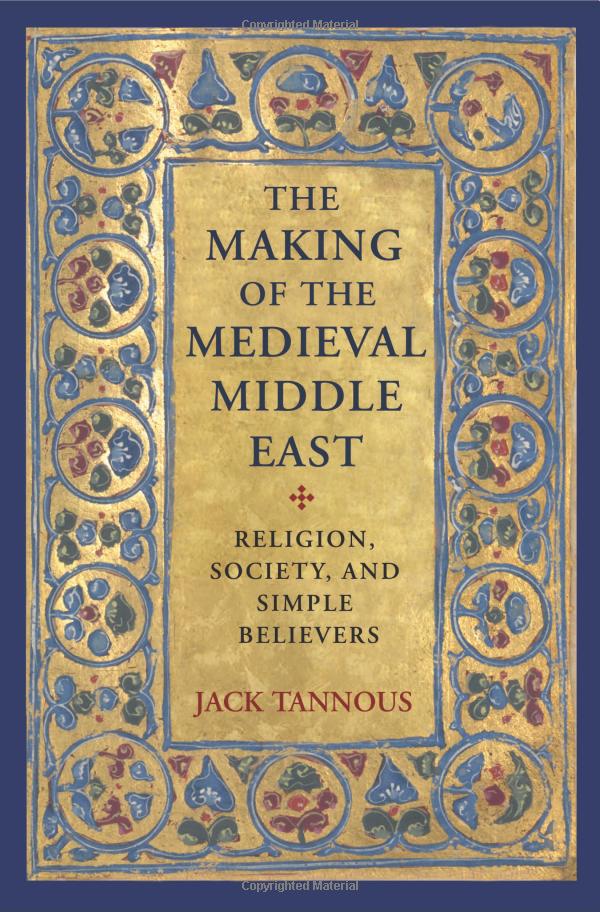
The Making of the Medieval Middle East
Religion, Society, and Simple Believers
Author(s): Jack Tannous
Reviewed by: Sajjad Rizvi
Review
In recent years, the study of early Islam has become quite a vibrant field, first moving towards the consensus on treating Islam as a ‘late antique’ religion and as part of the Near Eastern oecumene on matters ranging from the relationship between religion and violence to the perpetuation of monotheism (and henotheism), and then considering that the ‘standard’ narratives of the coming of imperial Islam in the region has tended to overemphasise the uniformity of the development of doctrine and practice and to marginalise the roles of non-Sunni elites in that process. Tannous’ study furthers this process by arguing for the role of ‘simple believers’, the illiterate and agrarian Christians who broadly constituted the majority of the inhabitants in the Near East for some centuries after the advent of the message of Muhammad in the Hijaz. In the preface, Tannous tells us that the study is motivated by two questions. First, what does it mean for someone relatively illiterate and theologically uninformed to belong to a church in late antiquity, especially where confessional identity might be defined by conciliar creeds that deploy sophisticated theological concepts that are not exactly quotidian? Second, how did the Middle East become transformed from being the cradle of Christianity and a Christian space to one in which Christianity was a minority?