BOOK REVIEWS
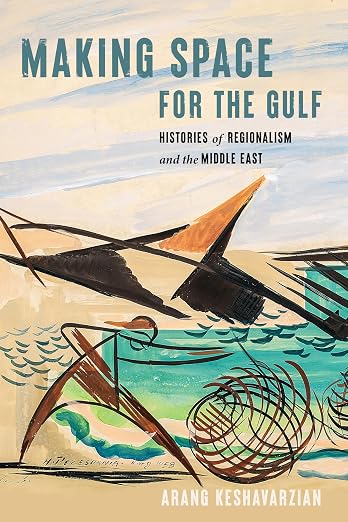
Making Space for the Gulf
Histories of Regionalism and the Middle East
Author(s): Arang Keshavarzian
Reviewed by: Najam Abbas
Review
Recent geopolitical developments continue to demonstrate how the Persian Gulf remains one of the global economy’s most volatile political and strategic theatres. It is true that conventional analyses often treat the region’s geography as a fixed, natural backdrop—an empty stage upon which states clash and oil flows – but Keshavarzian offers a much needed, highly perceptive corrective. By tracing a brutal sweep of political history alongside the intricacies of present-day spatial practices, the author questions these static assumptions. The book serves as a timely and helpful guide to understanding how the Gulf is not merely a pre-existing arena of conflict, but an actively constructed, highly contested social space caught up in the colliding currents of the past century and a half.
At the heart of Keshavarzian’s methodology is a “relational perspective” on the Persian Gulf. Historically, distinct literatures, policy think tanks, military commands, immigration regimes, and popular imaginations have partitioned the Gulf into siloed enclaves. These compartmentalized views reduce the region to a flat, two-dimensional plane defined solely by the interstate rivalry between Iran on one side, and the United States, Saudi Arabia, and the United Arab Emirates on the other.