BOOK REVIEWS
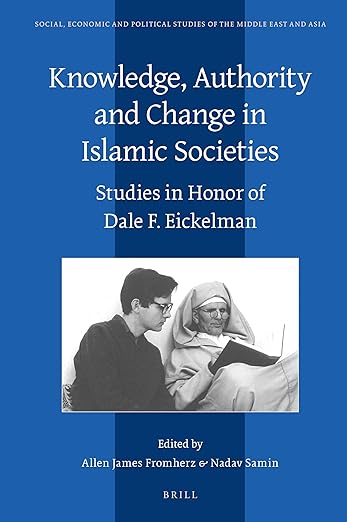
Knowledge, Authority and Change in Islamic Societies
Studies in Honour of Dale F. Eickelman
Author(s): Allen James Fromherz & Nadav Samin
Reviewed by: Gowhar Quadir Wani
Review
KNOWLEDGE, AUTHORITY AND CHANGE IN ISLAMIC SOCIETIES: STUDIES IN HONOUR OF DALE F. EICKELMAN, edited by Allen James Fromherz and Nadav Samin. Leiden and Boston: Brill, 2021, xv+308pp. ISBN: 978-9004439528.
Reviewed by: Gowhar Quadir Wani, Govt. Degree College Sogam, Jammu and Kashmir
The book under review is an edited volume in honour of Dale F Eickelman, one of the giants in the field of the anthropology of Islam. Born in 1942, Eickelman is Ralph and Richard Lazarus Emeritus Professor of Anthropology and Human Relations at Dartmouth College, USA . He is the author of several ground-breaking works in the field of Islamic Studies, especially the anthropology of Middle Eastern Muslim societies . These include Moroccan Islam: Tradition and Society in a Pilgrimage Centre (1976), Muslim Travelers: Pilgrimage, Migration, and the Religious Imagination (co-edited with James Piscatori, 1990), Public Islam and the Common Good (co-edited with Armando Salvatore, 2002), Muslim Politics (co-authored with James Piscatori, new ed., 2003), The Middle East and Central Asia: An Anthropological Approach, 4th ed. (2002), New Media in the Muslim World: The Emerging Public Sphere (co-edited with Jon Anderson, 2nd ed., 2003), Knowledge and Power in Morocco (1985), and Higher Education Investment in the Arab States of the Gulf: Strategies for Excellence and Diversity (co-edited with Rogaia Mustafa Abusharaf (2017), besides over 100 articles and book chapters.
In addition to an Introduction, the present edited volume is divided into three parts, aptly in accord with its title, each part comprising four chapters: Part 1 on “Knowledge”, Part 2 on “Authority” and Part 3 on “Change.” These twelve chapters arranged in three parts are written by twelve different scholars with their expertise in different specializations. This enlarges the scope of intellectual engagement of the book on the one hand but, on the other hand, makes a coherent and precise review of the book difficult.