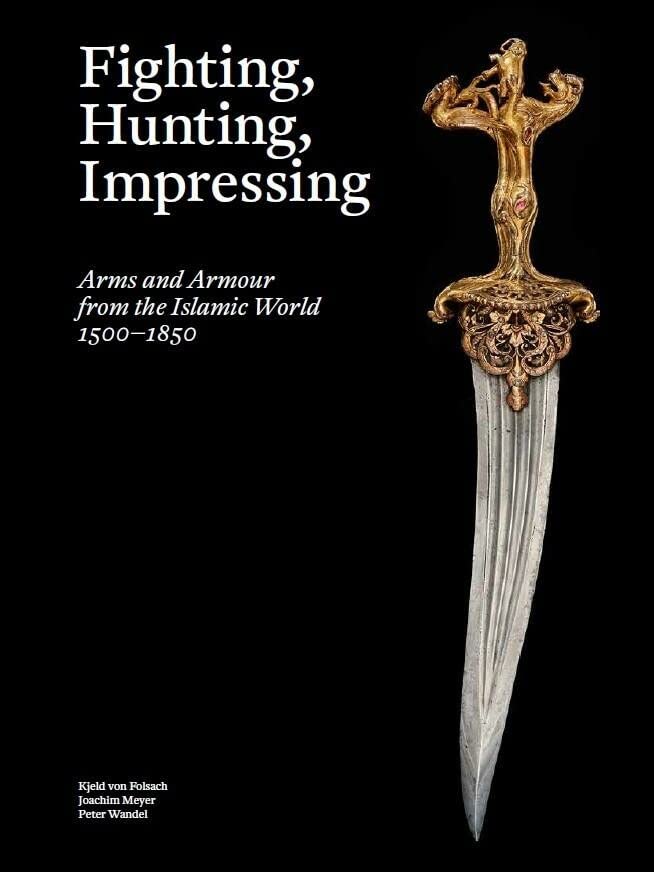
Islamic History
Fighting, Hunting, Impressing
Arms and Armour from the Islamic World 1500-1850
Author(s): Kjeld von Folsach & Joachim Meyer & Peter Wandel
Reviewed by: Abdullah Drury
Review
Reviewed by: Abdullah Drury, University of Waikato, New Zealand
Published by: Strandberg Publishing, Copenhagen, 2021, 296pp. ISBN: 9788792596109.
Published in conjunction with an exhibition at ‘The David Collection’ museum in Copenhagen from 24 February to 15 August 2021, Fighting, Hunting, Impressing: Arms and Armour from the Islamic World 1500-1850 discusses the central issues relating to Islamic arms and armour: the types and the different contexts in which they were used in warfare and hunting, and as symbols of social position. The aim here, being to elucidate “the craftsmanship, skill and artistic virtuosity” (p. 8). The book’s authors and editors are museum director Kjeld von Folsach, curator Joachim Meyer and curator Peter Wandel – all three from the David Collection. The book also contains substantial and vivacious contributions by Professor Thomas Hoffmann and independent research scholar Will Kwiatkowski. A major theme of this book is to uncover its meaning and suggest how ideas about the link between people and the land can flourish in countries with diverse political systems and traditions.
Fighting, Hunting, Impressing starts with a formal Introduction by von Folsach, an internationally acclaimed Danish art historian, and includes several essays by other writers covering subjects such as the roles of arms and armour in the Qur’an; their collection history from trophies to museum objects; their inscriptions; and furusiyah-literature, the manuals for the chivalrous Islamic warrior. Each essay contains both a critical analysis and apparatus, and this section constitutes the opening 95 pages. There follows 178 pages of photographs showcasing 151 items of arms and armour from the Ottoman, Safavid and Mughal empires, in addition to multiple miniature paintings that illustrate how the objects were used in their historical contexts. Each entry starts with a brief outline of the item’s name or title, date, dimensions, material, artist or manufacturer, provenance, and then a column or two describing the object; each sumptuous catalogue item and photograph is accompanied by an interpretative text of some scholarly insight regarding its artistic, historic and technical significance.