BOOK REVIEWS
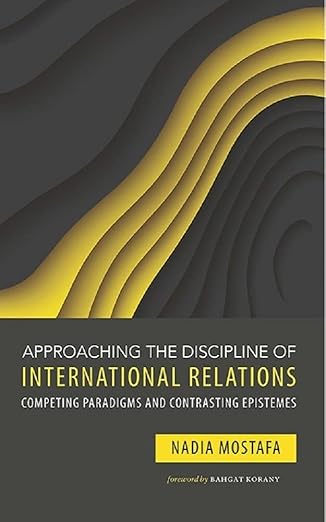
Approaching the Discipline of International Relations
Competing Paradigms and Contrasting Epistemes
Author(s): Nadia Mostafa
Reviewed by: Nazal Ul Islam Wani
Review
APPROACHING THE DISCIPLINE OF INTERNATIONAL RELATIONS; COMPETING PARADIGMS AND CONTRASTING EPISTEMES, by Nadia Mostafa. Herndon,VA/Richmond: International Institute of Islamic Thought, 2022, 312pp. ISBN: 978-1642056082.
Reviewed by: Nazal Ul Islam Wani, Government Degree College, Thannamandi, India
The book under review is a comprehensive and in-depth analysis of IRT (International Relations Theory), drawing on decades of teaching and research experience at Cairo university . The book accentuates the importance of non-Western and Islamic paradigm in contrast to dominant Western theories such as realism, idealism, liberalism, et cetera . Mostafa critiques the universal dominance of Western paradigms and proposes a substantial non- Western and Islamic framework based on the Qurʾān and Sunnah. It also aims to universalize IRT by incorporating perspectives from the marginalized Global South, offering a methodological and epistemological framework that challenges Eurocentric and American social sciences . It elaborates on methodology, conceptual framework, and epistemology that help in the paradigm building of IRT from a perspective other than Western, Euro- centric or ‘American Social Sciences’ by bringing in the civilizational and moral/normative perspective of Islamic paradigm.
The book is divided into four parts. Part I, “Introduction: Theorizing International Relations”, comprises two chapters. Chapter 1 serves as a methodological preface, emphasizing the importance of theorizing IR by understanding key distinctions such as the epistemological (the study of knowledge and how we understand and validate claims about IR), methodological (the study of methods), and ontological (the study of being and existence, exploring how theories conceptualize the nature of IR), differences between various IR theories, including Realism, Liberalism and Constructivism . The author aims to develop an inclusive paradigm that integrates the theories in IR (p.7).