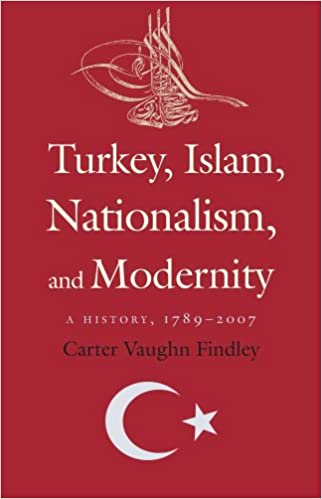
Contemporary Muslim World
Turkey, Islam, Nationalism, and Modernity
A History 1789–2007
Author(s): By Carter Vaughn Findley
Reviewed by: Murad Wilfried Hofmann, Bonn, Germany
Review
This is an absolutely splendid piece of historiography. The author, professor at Ohio State University and honorary member of the Turkish Academy of Science, is an award winning authority on Turkish history, replacing Stanford and Ethel Shaw, a generation ago famous for their History of the Ottoman Empire and Modern Turkey, 1808-1975. The author covers not only political, diplomatic, economic and social events but literary landmarks as well.
Secularized Turks wrote their Muslim opponents out of their historical narratives. Like them, Bernard Lewis believed that the country had become secularist for good. But for the author, this nostalgia for Kemalism has long been eclipsed by the Islamic renaissance in today’s Turkey – an Islamic response to globalization.
In fact, all the efforts of the Turkish State and its Westernized elites to control, and phase out, Islam merely served its propagation. Thus due to a ‘great Islamic awakening’ postmodern Turkey emerged as a Muslim nation with a Muslim government. Instrumental for this trend were:
i. Shaykh Khalid al-Baghdadi (1776-1822) whose Naqshbandiyyah order undermined Kemalist institutions;
ii. ‘Bediuzzaman’ Sa[id Nursi (1873-1960), creator of the Nurculuk Movement as a ‘modern response to modernity’; and,
iii. Fethullah Gülen (b. 1938), now Turkey’s most influential unofficial leader, living outside Turkey, extends his network of schools worldwide without religious advocacy.
Findley describes why the multinational, religious Ottoman empire could not survive the upsurge, both dynamic and destructive, of 19th century Young Turk nationalism. Thus, in no time, the Black Sea from an Ottoman lake turned into international waters (p. 26).
Masterful is the author’s concise descriptions of events, like Muhammad Ali Pasha`s rule in Egypt, the Crimean War, or the Alevi movement. In Muhammad Ali, Findley sees the first of many Muslim potentates over-estimating turn-key projects, as if technology could simply be bought.