Islamic Thought and Sources
The Quran in South Asia
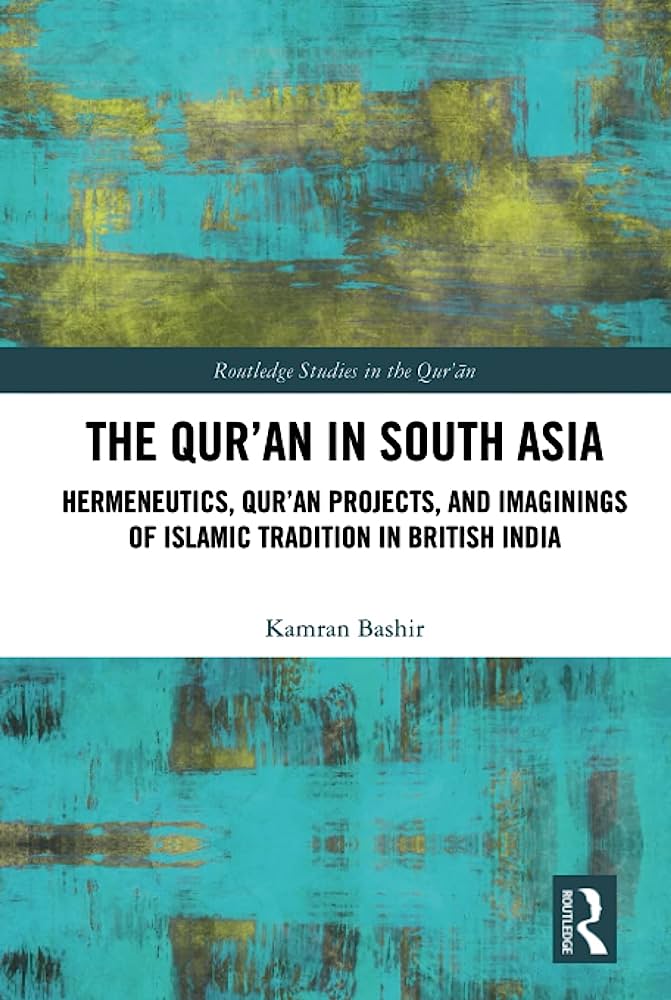
Hermeneutics, Quran Projects and Imaginings of Islamic Tradition in South Asia
Author(s): Kamran Bashir
Reviewed by: Abdur Raheem Kidwai
Review
Reviewed by: Abdur Raheem Kidwai, Aligarh Muslim University, India
Published by: Routledge, London, 2022, 278pp. ISBN: 9781032027890.
Notwithstanding the robust and vibrant tradition of tafsir writing in Urdu in the Indian subcontinent, this topic has received scant attention in academia. Only a couple of evaluative studies have so far appeared in English: (1) Abdul Kader Choughley, [The] Tradition of Tafsir in the Indian Subcontinent (Springs, South Africa, Ahsan Academy, 2021) and (2) The Quran Interpretation in Urdu: A Critical Study edited by Nazeer Ahmad Ab. Majeed (Aligarh Muslim University, K A Nizami Centre for Quranic Studies and Viva Books, New Delhi, 2019). Apart from these two attempts, a few assessments of the Tafsir works of Syed Ahmad Khan, Hamid al-Din Farahi, Abul Kalam Azad and Syed Abul A’la Mawdudi have occasionally appeared. It is therefore heartening to note the publication of Kamran Bashir’s in-depth study as part of the Routledge Studies in the Quran series. Essentially, this work has grown out of the author’s doctoral thesis on the subject at the University of Victoria, Canada. Though the study is focused on Urdu Tafsir works in British India up to 1947, with special reference to the contributions of Sayyid Ahmad Khan (1817-1898), Ashraf [Ali Thanawi (1863-1943) and Hamid al-Din Farahi (1863-1930), it displays the author’s wide familiarity with these authors’ works.
Some of the trend-setting, and influential Urdu works of Tafsir which merit estimation are by these distinguished Qur’an scholars: Shah [Abd al-Qadir, Mahmud Hasan and Shabbir Ahmad [Uthmani, Ihsanullah [Abbasi, Ahmad Riza Khan and Na[im al-Din Muradabadi, Muhammad Junagadhi, Thana’ullah Panipati, Thana’ullah Amritsari, Abul Kalam Azad, Mufti Muhammad Shafi[, Abdul Majid Daryabadi, Syed Abul A[la Mawdudi, Salah al-Din Yusuf, Sayyid [Ali Naqi Naqvi, Shams Pirzadah, Amin Ahsan Islahi, Altaf A[zami, Muhammad Karam Shah, Asrar Ahmad, Wahiduddin Khan, Tahirul Qadiri, [Abd al-Haqq Haqqani, Idris Kandahlawi, Khalid Sayfullah Rahmani and Javed Ghamidi. All these scholars have enriched Qur’anic scholarship in their own varied ways while adopting various approaches and tools which have expanded the contours of the field.