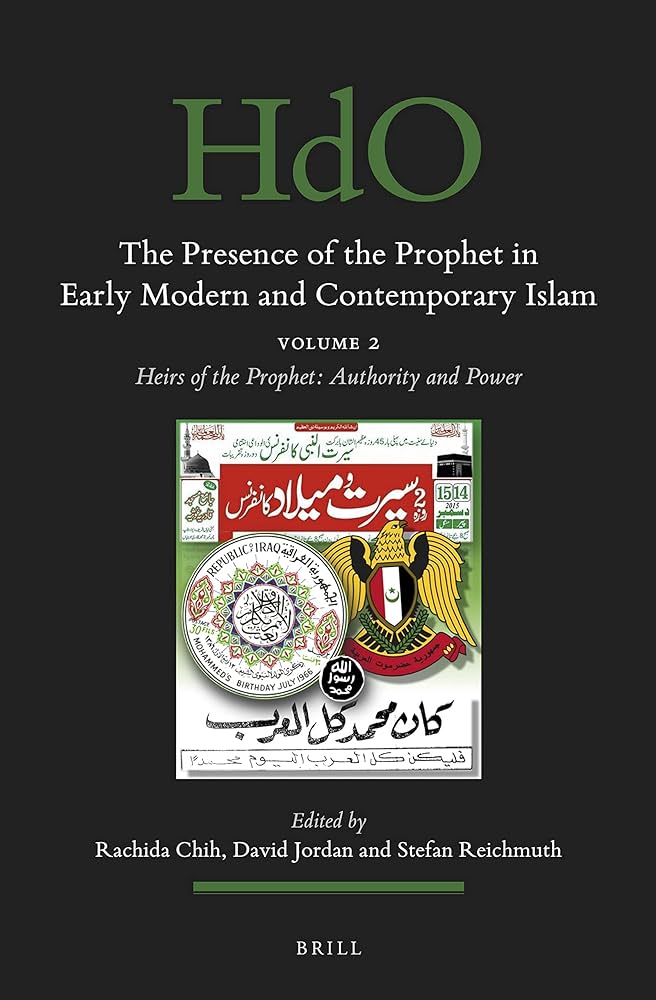
Islamic Thought and Sources
The Presence of the Prophet in Early Modern and Contemporary Islam, Volume 2.
Heirs of the Prophet: Authority and Power
Author(s): Stefan Reichmuth & Rachida Chich & David Jonathan
Reviewed by: Amidu Olalekan Sanni
Review
Reviewed by: Amidu Olalekan Sanni, Lagos State University
Published by: Leiden: Brill, 2022, xv+504pp. ISBN: 9789004466746.
This is the second of the trilogy which examines the portrayal and appropriation of the persona and life of Prophet Muhammad in pre-modern and modern times among Muslims. The volume under review is devoted to the examination of how the Prophet exercised religious and political powers. It also highlights the reflections and adaptations of those powers in the foundation of Muslim empires, revolutionary movements, ideologies, modern nation- states, communal mobilisation, and social reforms in selected societies in the Muslim world. Part 1 with the rubric “Empires and Revolutions” has three contributions (pp.21-117). The Ottoman royal piety at the courts is discussed through the lens of the discourse on the Prophet’s nativity (Gotfried Hagen 21-43) The remoulding of the image of the Prophet by Muhammad Ibn [Abd al-Wahhab (d.1792) in his abridged Vita of the Prophet (mukhtasar sirat al-rasul) is examined by Martin Riexinger (pp.44-77). Riexinger shows how the author obfuscates, or at least, underplays the charismatic and superhuman attributes of the Prophet in favour of a simple Prophetic model, an approach which earned Ibn [Abd al-Wahhab the opprobrium of the Sufis who were known for their concept and practice of veneration of the Prophet and saints. Stefan Reichmuth (pp. 78-117) mentions four features that are widely shared in respect of attachment to the Prophet among the various movements of the period (ca. 1775-1850), the so-called Muslim Age of Revolution. These are reliance on the Hadith, orientation towards Madinah and creation of local memorial landscapes that are connected to the Prophet, programmatic evaluation of the Prophet, and cultivation of eschatological expectations, including the portrayal of movement leaders as Mujaddid (Renewers of faith).
Part 2, “Prophetic Descent and Authority” (pp. 121-207) opens with a contribution in Arabic by J. Soulami (pp. 121-141) in which he bemoans the lack of attention to genealogical studies among Sunni scholars, especially in respect to the legal suzerainty of the Syndicate of the descendants of the Prophet (niqabat al-ashraf) in Morocco, and indeed the general application of the concept of niqabah in the Islamic polity as robustly discussed in al-Mawardi (d. 450/1058) (pp.142-146). Related to this is the discussion (in French) by C. Mayeur-Jaouen (pp. 172-207) on the verification of the genealogy of niqabat al-ashraf in contemporary Egypt. Soraya Khodamoradi (pp. 147-171 examines a solution proffered by a Sharifian Sufi poet Mir Dard (d. 1199/1785) to the sectarian dissent and disputation between Sunnis and Shi[is of Mughal India.