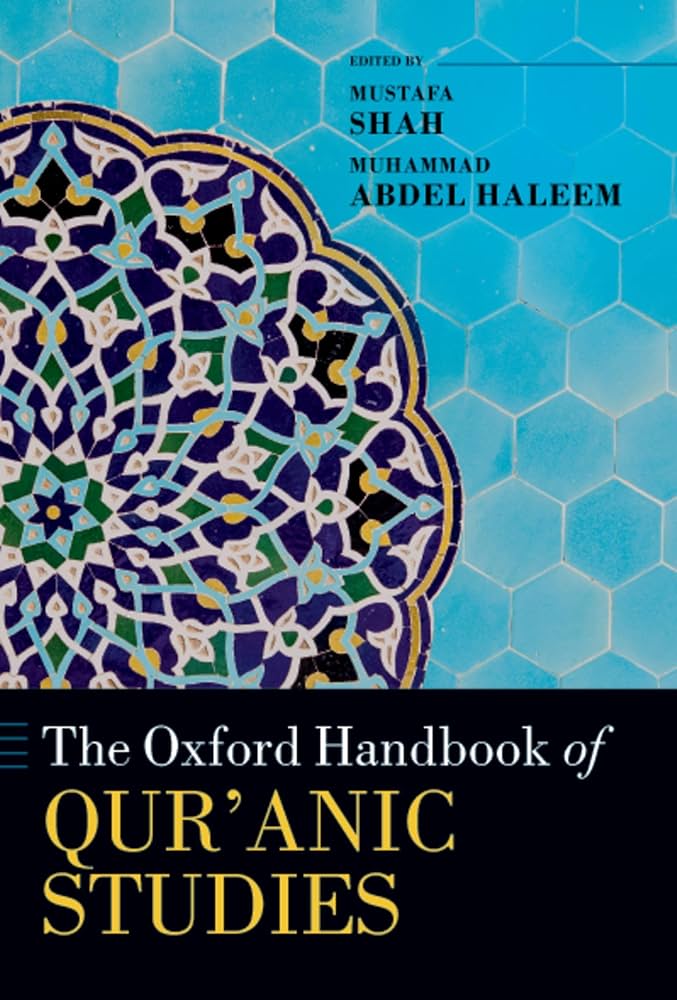
Islamic Thought and Sources
The Oxford Handbook of Qur’anic Studies
Author(s): Mustafa Shah & Muhammad Abdel Haleem
Reviewed by: Abdur Raheem Kidwai
Review
Reviewed by: Abdur Raheem Kidwai – Aligarh Muslim University, India
Published by: Oxford: Oxford University Press, 2023, 1003pp. ISBN: 978-0198896203.
What an irony that this collection of 57 articles, mostly by revisionist scholars who “dismiss sira and hadith as well as other sources [including even the Quran] about the late sixth-and early seventh-century western Arabia as tendentious and anachronistic” (p.66), is edited by two Muslims. This is either a marketing ploy or a manifestation of the typical deceit of the Orientalists to mislead unsuspecting readers. That it serves mostly as a vestibule for venting some revisionist scholars’ distrust, nay rejection, of the origin of Islam/the Qur’ān/the Sīrah by way of relocating the emergence of Islam to a period as late as the ninth century, is confirmed by a refrain-like reference to Andrew Rippin in Anna Akasoy’s introductory article on Qur’ānic studies (p. 65). Worse, even a die-hard polemicist and Islam basher, Ibn Warraq, a pseudonym for a pathetic enemy of Islam, is paraded as an authority on the Qur’ān. (p. 67). Likewise, other writers who are extremely hostile to Islam receive in this volume idolatrous endorsements: John Wansbrough, Christoph Luxenberg, Nasr Hamid Abu Zayd, Patricia Crone, Gunter Lulling (pp. 66, 67, 72) Michael Cook (p. 65) and Ignaz Goldziher (p. 73).
Articles 1-4 under the rubric, “The State of Qur’anic Studies” (pp. 27-77) set the agenda of the volume which embraces the following thematic concerns: 11 articles on “The Historical Setting of the Qur’an;” 6 on “The Qur’an: Textual Transmission, Codification, Manuscripts, Inscriptions and Printed Editions”; 5 on “The Qur’an in Context: Translation and Culture”; and 11 on “Qur’anic Exegesis: Discourses, Formats and Hermeneutics.”