Islamic Thought and Sources
The Noble Quran
Author(s): Mufti A. H. Elias
Reviewed by: Abdur Raheem Kidwai
Review
Reviewed by: Abdur Raheem Kidwai – Aligarh Muslim University, India
Published by: New Delhi: Islamic Book Services, 2024, 1092pp. ISBN: 9351691667.
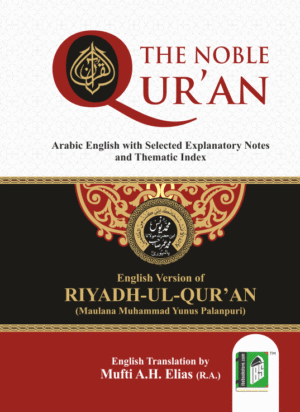
Though the work under review is projected as the English translation of the Indian Tablīghī Jamāʿat activist, Muḥammad Yūnus Palānpūrī’s Urdu translation of the Qur’ān, Riyāḍ al-Qur’ān (2018), it is a hybrid work, marked by many additions and omissions. First a word about the omissions. The original work carries an extensive introduction touching upon the excellence of learning and teaching the Qur’ān; the merits of the Qur’ānic sūrahs and Qur’ānic supplications and details about the chronology of the sūrah. All this material does not appear in the English translation under review. Instead, it contains scores of explanatory notes on several Qur’ānic events, terms and personalities. Presumably these have been inserted by the English translator, Mufti Afzal Hoosen Elias (1955-2018), a South Africa based Islamic scholar who has authored several books on Islam, including his own English translation of the Qur’ān, Quran Made Easy (Karachi, Zam Zam Publications, 2015). His and the translation under review are representative of the tafsīr bi’lma’thūr and both have a strong affiliation with the Deoband/Tablīghī Jamāʿat. Little wonder then that the main thrust of the notes is on commonplaces, mostly about the Prophet’s battles, and restricting the meaning of the Qur’ānic verses to their immediate circumstantial setting (asbāb al-nuzūl), which regrettably tends to present the Qur’ān as a somewhat dated work, hedged in by the time and place of its revelation. The author makes no attempt to relate the meaning and message of the Qur’ān to our times. An exposition of the Qur’ān intended for today’s English-speaking readers should spell out the eternal Qur’ānic guidance regarding the following challenging questions: terrorism, peaceful coexistence, gender parity, Islamophobia, Muslims as minorities, maintaining Muslim identity in the face of the global ascendancy of right-wing ideologies, and the current atheistic and godless way of life steeped in crass materialism. Needless to add, the basic objective of tafsīr has all along been to expound the Qur’ānic message with an eye on the burning issues of the day. Tafsīr should and does show a way out in the light of the timeless guidance of the Qur’ān.