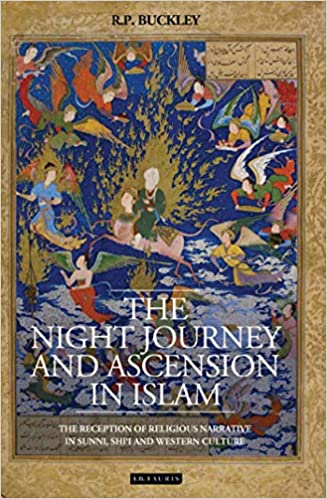
Islamic Thought and Sources
The Night Journey and Ascension in Islam
The Reception of Religious Narrative in Sunni, Shi'i and Western Culture
Author(s): R.P. Buckley
Reviewed by: Sajjad Rizvi
Review
One of the pivotal episodes in the sacred history of early Islam – and one that according to some sources took place more than once – is the famous ascension (mi[raj) of the Prophet. The narratives in various sources that discuss it make clear the significance of the event(s) especially for both the theology of prophecy in Islam as well as the legitimation of narratives about the status of his successors. The ascension had an important reception in European literature, not least in various accounts about the ascent into heaven or the descent into hell including Dante among others. It also played a role in polemics – both intra-Muslim ones, and also Christian-Muslim ones. In recent years there has been a rise in interest in the study of the mi[raj and its theological and artistic implications. For example, Christiane Gruber and Frederick Colby edited a volume on cross-cultural influence in different Muslim literatures published in 2010 by Indiana University Press. Earlier, Mohammad Ali Amir-Moezzi, who has written extensively on ascension narratives in classical Shi[i texts, edited a volume entitled Le voyage initiatique en terre d’islam published in Paris in 1996 that included studies of the medieval European reception of the mi[raj narratives. More recently, Brooke Olson Vucukic published a book with Routlege in 2005 on the significance of mi[raj narratives in the formative literature of Islam. So there is an overlap between some of these studies and the concerns of Buckley who seems to be aware of these studies as well as a number of recent works in Arabic. One cannot, of course, expect Buckley’s study to be exhaustive given the many works on the narratives published in Persian, Turkish, Urdu and other languages used by Muslims.