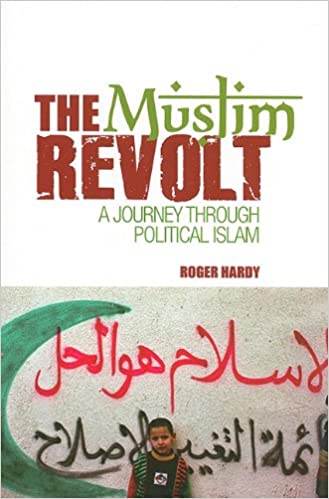
Islamic Thought and Sources
The Muslism Revolt
A Journey Through Political Islam
Author(s): Roger Hardy
Reviewed by: Anis Ahmad
Review
The book under review offers an overview of what is happening in Sudan, Saudi Arabia, Turkey, Indonesia, Malaysia, Pakistan and Iran. Being attached to BBC, Hardy had direct interaction with Muslim intellectuals, activists and common men in the street. With a sharp critical approach, Hardy has put together a wealth of information on the responses of Muslim scholars, common men and the ruling elite on a number of contemporary socio-political issues.
The journey through political Islam begins with an effort to define Islam as a religion, society and civilization, ‘contrary to popular belief,’ observes Hardy, ‘the Arabs did not as a rule impose Islam at the points of a sword. Their language, Arabic, spread fairly slowly and their religion more slowly still. It was not until the period between the tenth century and thirteen that the mass of Middle Eastern people were converted to Islam… for practical purposes: the empire worked as a Muslim than a purely Arab enterprise’ (pp. 11–12).
Hardy tries to understand the spirit behind a global desire in the Muslim masses to have an Islamic state or the Shari[ah as law. He cannot be blamed for his rather simplistic treatment of how Muhammad Ali Jinnah visualized Pakistan. The common misconception about Jinnah is reflected in his analysis of him as a secular and liberal person (p. 59). The fact of the matter, though, is that Jinnah, prior to the creation of Pakistan and after it came into existence, repeatedly expressed his vision of Pakistan as an ‘Islamic State’ (see: his address to the people of US on February 23, 1948). In another statement he cautioned those who tried to confuse the issue: ‘No doubt there are many people who do not appreciate when we talk of Islam. Islam is not only a set of rituals, traditions and spiritual doctrines. Islam is also a code for every Muslim which regulates his life and his conduct even in politics and economics and the like. It is based on the highest principles of honour, integrity, fair play and justice for all.’