Islamic Thought and Sources
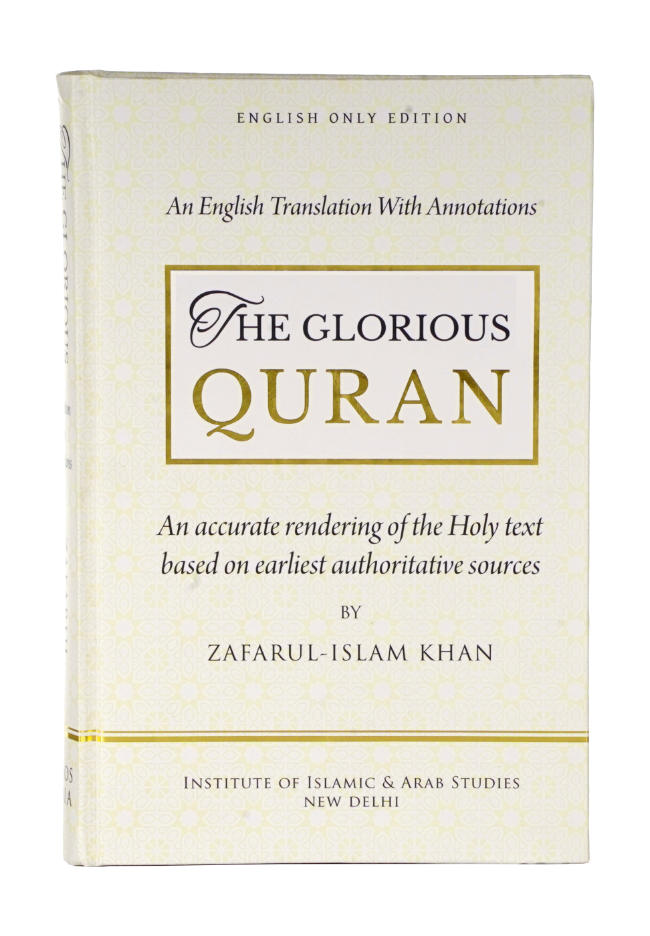
The Glorious Quran
An English Translation with Annotations
Author(s): Zafarul Islam Khan
Reviewed by: Abdur Raheem Kidwai
Review
Reviewed by: Abdur Raheem Kidwai, Aligarh Muslim University, India
Published by: New Delhi: Institute of Islamic and Arab Studies, 2023, 1234pp. ISBN: 978-8172211349.
With around 150 complete English translations of the Qur’ān, mostly carried out in the 21st century (both in print and e-forms), a new one can only justifiably carve out its place if it stands out for certain distinctive features in both conception and execution and, most importantly, in its presentation skills and user-friendly devices. On the reason behind embarking on this venture, Zafarul Islam Khan (b. 1948), an activist in the affairs of post-Independent Indian Muslims, states: “The translation started over a decade ago as a revision of Abdullah Yusuf Ali’s English translation (1934-1937).” However, “this translation is hardly a revision… it may be treated as a new work (pp. 15 and 16). Khan’s affirmation is perfectly justified. It is not vitiated by any of the serious flaws in Abdullah Yusuf Ali’s translation: his Ismāʿīlī mind-set which is at work in the interpretation of several Qur’ānic verses, his unpardonable dismissal of the Qur’ānic account of all matters pertaining to the Unseen (al-ghayb), and his treatment of miracles as allegories and figurative expressions as well as in his irksome use of archaic English expressions and syntax.
Another strand of Khan’s approach, in his own words, has been “to avoid academic or comparative comments” (p. 17). That his work is not academic is his understatement steeped in humility and modesty. His is a well-documented, properly cited work, meeting the requisite of academic standard. His critique on the Bible underscores his sterling scholarship. As to his avoidance of “comparative” comments, at places, one wishes he should have, at least, pointed to the stance of some deviant sects, and particularly the Qadyanis. His silence regarding some sensitive issues has deprived the readers of Qur’ānic guidance. His stance of hyperobjectivity in certain instances has resulted in doing somewhat a disservice to the readers, a point which would be illustrated below. In his explication of things Qur’ānic, he has largely drawn on the views “of the earliest scholars of Islam” (p.17). Occasionally, however, he touches on today’s problems and challenges, though regrettably without providing Qur’ānic ways out. In a few instances, illustrated below, he expresses his personal views which is problematic.
“The Translator’s Note” (pp.13-20), lucidly describing the intent, is followed by “An Introduction to the Quran” (pp.21-44) which mostly states commonplaces, with the following two exceptional sections: (i) “Scientific Indications of the