Comparative Religion and Interfaith
Tabyin Al-Kalam
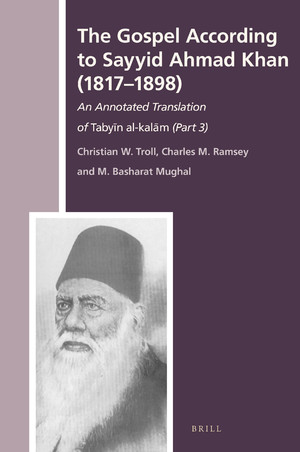
The Gospel According to Sir Syed Ahmad Khan (1817–1898)
Author(s): Christian W. Troll & Mahboob Basshart Mughal & Charles Ramsey
Reviewed by: Abdur Raheem Kidwai
Review
As part of the Aligarh Muslim University Centenary commemoration, Sir Syed Academy, Aligarh Muslim University, Aligarh, India, has done a good job in bringing out its founder’s, Sir Syed Ahmad Khan (1817–1898), neglected and little known work Tabyin al-Kalam. It has been ably translated and annotated by the acclaimed academic Christian W. Troll and his team. The Urdu original was published in 1860 and was out of print for a long time. The Tabyin stands out as one of a very few academic studies of the Bible undertaken by Muslim scholars. What lends more importance to this work is that Syed Ahmad Khan’s sober and critical exposition of the Bible came out when bitter polemical writings were rife in 19th century British India. One of the contributing factors for this was the British Parliament’s 1813 India Act which allowed missionary work in colonial India. The raucous Agra polemical debate of 1854 between Rev. Karl Pfander and Rahmatullah Kayranawi had negatively impacted Christian- Muslim relations. Moreover, upon the fall of the Indian Muslim empire in 1857 and its annexation by Britian, there had been large scale persecution and execution of Muslims in post-1857 India. Both communities were given to demonizing each other.
Against this backdrop, Syed Ahmad Khan took up the cudgels for interfaith Dialogue. His attempt represents a remarkable feat of moral courage and academic integrity. He carried out this daring venture in the insulated and self-contained British India of the 1860s when an unmistakably exclusivist attitude towards other faiths had prevailed. Far from being a narrow, vitriolic polemical work, the Tabyin is an earnest, warm-hearted attempt at forging better Christian-Muslim relations. It is grounded thoroughly in the Islamic ideals of peaceful coexistence and respect for all religions. This is evident from the full title of the work which reads as: Elucidation of the Word through the Commentary on the Torah and the Evangel for the People of Islam. In the Urdu original, the work is introduced as a tafsir of the Holy Bible. The choice of the term tafsir, associated in the Muslim mind with the elucidation of only the Qur’an, for the Bible seeks to press home the point that the Bible deserves equal esteem. The same consideration is behind Syed Ahmad Khan’s use of the appellation “Honourable Messiah/Jesus/Mary” throughout the work.