Contemporary Muslim World
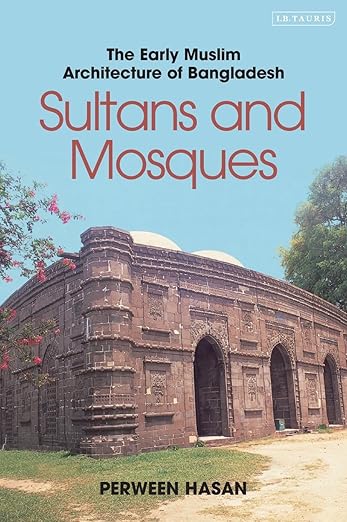
Sultans and Mosques
The Early Muslim Architecture of Bangladesh
Author(s): Perween Hasan
Reviewed by: Abdullah Drury
Review
Reviewed by: Abdullah Drury, University of Waikato, New Zealand
Published by: London: I.B. Tauris, 2024, xiii+241pp. ISBN: 978-0755653607.
- - - - - - - - - - - - - - - - - - - - - - - - - - - - - - - - - - - - - - - - - - - -
This is a fascinating book. Perween Hasan is a genius with a gift for writing about complex subject matter. The author has a force of persuasion and consistency of argument that stamps the book as a whole with real authority. It is no surprise that she obtained her PhD at Harvard University and worked with Oleg Grabar.
Before the Mughal style came to dominate Islamic architecture in the Indian subcontinent, Bengal and its rulers had developed unique architectural forms deeply rooted in the indigenous vernacular architecture of Bengal, which itself drew considerable influence from Hindu and Buddhist temple traditions. The mosque architecture of Bengal during the Independent Sultanate period (14th to 16th centuries) stands out as a significant aspect of Islamic architecture in the region. The distinctive style of the early Muslim architecture of present-day Bangladesh constitutes a fascinating yet underexplored chapter in the architectural heritage of both the Islamic world and the Indian subcontinent. The work of Perween Hasan here provides the reader – whether scholar or lay-person – an original and valuable contribution to this field of study.
That this book is a reprint of the original 2007 masterpiece is a testimony to the impact of the text and the high regard with which it is held in academic circles. There are over 170 black and white photographs, figures and architectural plans. The book contains three useful appendices featuring lists of independent Muslim rulers of Bengal and other pertinent points. Finally, there is an excellent glossary for specialists, detailing relevant words and terms in Arabic, Bengali, Burmese, Persian, Sanskrit and Turkic.