Islamic Thought and Sources
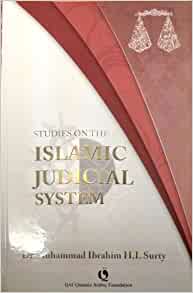
Studies on the Islamic Judicial System
Author(s): Muhammad Ibrahim Hafiz Ismail Surty
Reviewed by: Murad Wilfried Hofmann, Bonn, Germany
Review
The book under review is the product of a life devoted to the study of Allah’s revelation and its propagation, and that by a man whose knowledge of all things Islamic is as pronounced as his protruding love for this religion. The author (72), while born and educated in India, mainly taught in Nigeria (Sokoto) and Birmingham (Britain). He was also associated with the Islamic Foundation and the Selly Oaks Centre for Islam and Christian-Muslim Relations.
This is a monumental work. Its annexes, covering 310 pages, make up 40% of the volume. Listed are no less than 1.844 books from the author’s own library of 6500 – an apparatus reflecting supreme erudition, fifty years of research, and a unique collection of literature on the Islamic judicial system. Against this background, a little tendency of self-appreciation, here and there, is to be excused.(pp. 23-25)
The first chapter (pp. 33-75) might be most useful for Muslim readers, intensively dealing as it does with the largely overlooked Jahiliyyah period – describing no less than eleven gods, from Hubal to Ya[uq, including those mentioned in the Qur’an. (71: 23)
It is very instructive indeed to read Jahili odes and couplets, making one fall back into a world dominated by local arbitrators (tiukkam), soothsaying (takahhun), and fortune-telling ([arafah). Surty provides details on the career of 25 male and female pre-Islamic arbitrators. They mainly dealt with internecine tribal conflicts, including ludicrous ones about the genealogy of a horse.
The historical details unearthed by the author are amazing, given that the earliest surviving Arabic book on courts of law is al-Khassaf’s 9th century Adab al-Qadi. The following literary and historical analyses provide exact meanings for terms like [adl, zulm, fasad, tiaqq, taqwa and itisan. On this basis the author next deals with Qur’anic Judicial Principles like ‘Any decision based on mere conjecture is to be treated as void’ or ‘Contracts made with non-Muslims must be honoured’.