Comparative Religion and Interfaith
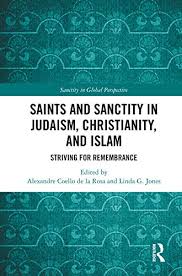
Saints and Sanctity in Judaism, Christianity, and Islam
Striving for Remembrance
Author(s): Alexandre Coello de la Rosa & and Linda G. Jones
Reviewed by: Kemal Enz Argon, Konya,Turkey
Review
As the authors of this book note, comparisons between Christianity, Judaism, and Islam exhibit important differences and similarities in their respective conceptions of “sanctity;” in the literary and cultural productions associated with the cult of saints and pious heroes and in the social, historical, and political contexts in which “sainthood” operates. “Sanctity” is socially configured in a multitude of ways in Jewish, Christian and Islamic cultures.
Alexandra Cuffel offers a general chapter, “Holiness, Saints, and Sanctity in Judaism,” mapping the beliefs and practices regarding the “holy dead” and “saintly living.” There is a perspective that locates these matters on the periphery of biblical and rabbinical Judaism. Judaism’s radical aniconism and its adverse stance toward venerating the dead militated against the elevation of certain individuals above others as objects of devotion. Nonetheless, some individuals did become “sanctified” in Jewish collective memory, which has led some to argue that the veneration of these “saints” and “sacred” places associated with them was not peripheral but rather a normative part of Jewish practice.