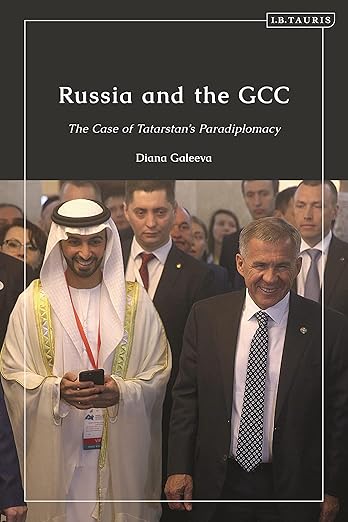
Contemporary Muslim World
Russia and the GCC
The Case of Tartastan’s Paradiplomacy
Author(s): Diana Galeeva
Reviewed by: Najam Abbas
Review
Reviewed by: Najam Abbas – London, UK
Published by: London: I. B. Tauris, 2023, 272pp. ISBN: 978-0755646197.
The place of Muslims in Russia corresponds to a complex, multi-layered and multi-faceted reality. Despite Muslims being Russia’s second largest religious community, the essentialist ethnicity-security lens continues to act as an obstacle for them in expanding ties with Muslim countries. In the Middle East, Russia has generally pursued a strategy driven by a need to seek allies while avoiding political upheaval, undesired US influence, or allowing space for fundamentalist tendencies. Some officials seek improved relations to bring investments, whereas others see this as perilous. Such preoccupations define Russia’s position and determine its actions towards the Persian Gulf states. Galeeva’s book provides an aperçu of the prevalent Russian perceptions which see relations with some Muslim states as assets and with others as liabilities.
The Russian 2016 Foreign Policy concept paper identifies the Middle East as a region where instability can produce a direct impact on Russia and also where specific economic objectives can be gained if Russia collaborates with the GCC states. The spheres of potential Russian expansion include sales of weapons, nuclear technology, oil and gas industry machinery and food supplies, as well as bringing investment to Russia and coordinating action with key energy suppliers in the GCC countries to maintain energy prices favourably (p.111), and it remains crucial for Russia to collaborate on energy policies with the GCC in order to stabilise the energy market.