Contemporary Muslim World
Routledge Handbook of the Arab Spring
Rethinking Democratization
Author(s): Larbi Sadiki
Reviewed by: Elfatih Abdullahi Abdel Salam, International Islamic University, Malaysia
Review
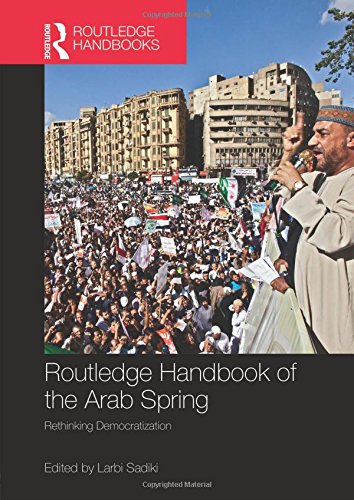
Four years after its eruption, the Arab Spring saga continues to capture the interest and concern of scholars. In the Routledge Handbook of the Arab Spring, there is no fixed or single meaning given to the term ‘Arab Spring’. The kind of fluidity that informs the Arab Spring is mirrored in the handbook. The editor claims from the outset that it is futile to attempt to impose one meaning or to try to disaggregate the phenomenon into its constitutive manifestations, whether ‘uprisings’, ‘protests’ or revolutions. While all these labels indicate nuance, and signify specific dynamics, they owe their existence to the common symbolism of bottom-up change and the forces driving it. Moreover, they all capture the essence of an historical moment, still unfolding. Integral to this moment is the anomic condition that grips societies determined to overthrow existing brutal and exclusionary regimes. The Routledge Handbook of the Arab Spring should not be read with the wrong paradigm in mind. The book does not make any bold claims to be theoretical. It is primarily intended to collate the initial analyses of the events imploding in 2011 up to the present. The strength of the handbook lies in the fact that it is enriched by a variety of styles and even levels of experience. In addition, it represents a kind of ‘transgenerational’ work in terms of academic experience, combining the works of renowned and established scholars with the inputs of young researchers.