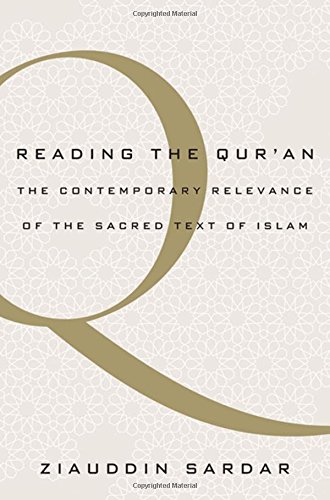
Islamic Thought and Sources
Reading the Quran
The Contemporary Relevance of the Sacred Text of Islam
Author(s): Ziauddin Sardar
Reviewed by: Abdur Raheem Kidwai
Review
Although this book is highly ambitious in its conception – seeking to establish the relevance of the Qur’an, the Word of God, in the face of numerous challenges and concerns of our times – the author himself at the very outset states his lack of expertise in the highly specialized field of Qur’anic studies: “Indeed I have no qualms in admitting that I am not the most qualified person to talk about the Quran, let alone offer my own particular reading of the text and its meaning. I am not a hafidh [sic], an Imam or an ‘alim (a religious scholar trained for years in a religious seminary); although, on certain bad days, I do imagine myself as a Muslim thinker of some repute. Worse: I don’t even speak Arabic” (p.xiv). Little wonder then that Sardar’s work does not engage with the classical Muslim corpus of Tafsir and Fiqh. Instead, he prefers to write about what the Qur’an means to him in today’s context. Divided into four parts, the work embodies Sardar’s numerous observations which he thinks constitute the meaning and message of the Qur’an, Qur’anic themes and concepts, and his attempt to grapple with some contemporary issues in the light of his own reading of the Qur’an. At times this exercise is engaging, thought-provoking and introspective, but it is mostly outlandish and outrageous. Let us begin with the statement of his intent in the Prologue: “I argue that many of its [Qur’anic] verses, such as those on women and crime and punishment should be read in this context; and understood in terms of their spirit rather than specific injunctions” (p.19, italics mine).