Islam and the West
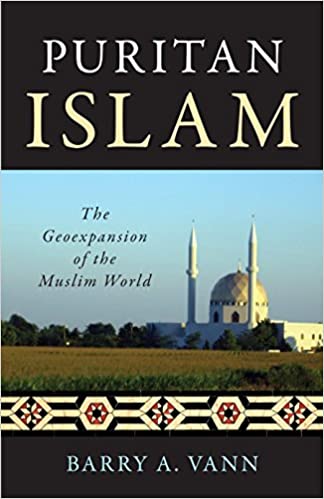
Puritan Islam
The Geo Expansion of the Muslim World
Author(s): Barry A. Vann Amherst
Reviewed by: Ian G. Williams, Markfield Institute of Higher Education, Birmingham, UK
Review
Of approaches to the study of religions there is a repertoire of academic disciplines available. In this text a fresh set of expertises is deployed from the perspective of Geography and Demographic Studies.
The result is an insightful and revealing examination of the ways in which ‘Puritan Islam’ is perceived as influencing understandings of community and geographical spaces. Muslim communities made up of recent immigrants are an increasingly common part of society in Western Europe, North America, and South America. Unfortunately, this has sometimes resulted in conflicts between long-established residents and the new arrivals that are not ameliorated by generational change. This is especially true of Muslim migrants from a very traditional, or as Vann uses the term a ‘puritan’, background, who have radically different notions of self, community, governance, and nation, to citizens of the majority Christian traditions, other longer established faith groups such as the Jewish expressions and secularised citizens.
The very use of the term ‘puritan’ in this text is cogent but imbued with a heritage from use in strictly Christian theological and historical contexts. For this reviewer, from a Christian theological perspective and practice, such a term is contentious. The word ‘puritan’ carries synonyms of iconoclasm and failed experiments in governance such as the Commonwealth Period in Britain of de facto 1649–1660, and the inheritance of six New England states from 1620–1776.