Islamic Thought and Sources
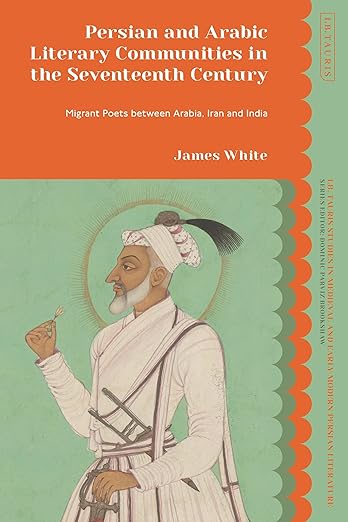
Persian and Arabic Literary Communities in the Seventeenth Century
Migrant Poets between Arabia, Iran and India
Author(s): James White
Reviewed by: Sajjad Rizvi
Review
Reviewed by: Sajjad Rizvi, University of Exeter, UK
Published by: London: I.B. Tauris/Bloomsbury 2023, xvi+255pp. ISBN: 978-0755644568.
- - - - - - - - - - - - - - - - - - - - - - - - - - - - - - - - - - - - - - - - - - - -
Now and then one comes across a volume that speaks and excites in such a manner that, instead of the critical stance in which one thinks: that is not how I would have written it, one wonders: wow, this is the book that I wish I had written! It speaks to me for four reasons: first, it is about the Persianate sphere in the early modern period and does not fail to show how the Persianate is very much the Arabo- Persian cosmopolis in which elite multilingualism also implicates the vernacular and in which the assumed distinction of the Arabic and Persian cosmopolities “bleed into each other.” Second, it concerns connected histories which are very much the way to transcend the insularity of nationalist historiographies as well as the more conservative and politically motivated conceptions of area studies – and takes this in the direct of the cultural, the literary, and the intellectual. Third, it considers a cosmopolitan elite milieu, which despite the conflicts and antagonisms of the Ottoman-Safavid conflict and the shifts in “Alid devotionalism,” that still engages intellectually and culturally without sectarian prejudice. Fourth, unlike our oft-considered binary between the theoretically sophisticated and the precise and careful philological study of texts, White engages both – the former with a series of interventions on the nature of text, world literature, and literary production in literary criticism usually in European contexts (and that comparative is also useful), and the latter with extensive consideration of unpublished manuscript sources that demonstrate the way in which intertextuality is not primarily about the death of the author or indexing and invoking major figures (even with the anxiety of influence) to enhance the work of minor figures but rather our presentist neglect of the “minor” might skew our understanding of those literary communities.