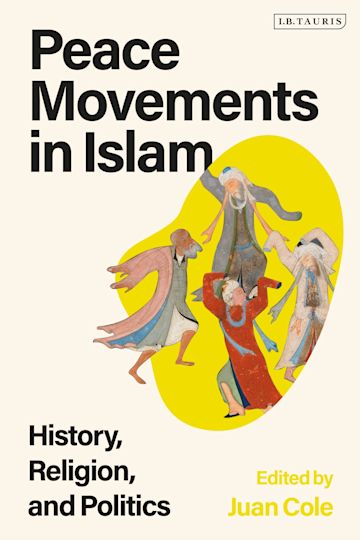
Islamic Thought and Sources
Peace Movements in Islam
Author(s): Juan Cole
Reviewed by: Saad Khan, National School of Public Policy, Pakistan
Review
Publisher: I.B. Tauris, London: 2022, 224pp. ISBN: 9780755643172
Islam, like any religion, is a set of practices, traditions, ideas and experiences which are as diverse as its adherents are. Is Islam intrinsically intolerant or even violent? Not more so than any other religion on planet earth. Scriptural support for coercive activities can be found in almost all religions whose followers relied on them for intellectual justification for empire building throughout history. However, the editor of this volume tells us that his google n-gram searches for “militant Islam”, (a count of occurrence of the term in google books), throw up a “Himalayan peak” of results, while a similar search for “pacifist Islam” gives no n-gram result at all. This is despite the fact that, according to his calculations, people of Christian heritage were responsible for over 100 million deaths in the 20th century while those of Muslim descent caused about three million fatalities in the same century (p. 4). Muslim contributions in anti-Apartheid activism, Gandhian-style politics by Muslims in colonial India, the Arab spring as the Muslim version of the civil rights’ movement, West African Sufi orders abhorring violence and countless other contemporary peace movements within Islam have seldom been systematically studied. However, the volume under review, consisting of eleven chapter-length contributions, is a bold yet singular addition to the discourse on pacifist streams in Islam where there are resources galore on militant Islam.
In the opening chapter, Rashied Omar highlights Qur’anic verses related to justice and compassion and argues that wherever there is a tension between the two, the Islamic spirit dictates that the latter trumps the former. Hence, there is a need to highlight contemporary Islamic scholarship on peace and pacifism such as that reflected in the writings of Chandra Muzaffar, Waheeduddin Khan, Asghar Ali Engineer, Rabia Harris, Farid Esack and others. The second chapter, contributed by the volume’s Editor, is interesting as it argues that the Qur’anic exhortations to fight for a just cause are no different from Augustine’s theory of “just war”. Hence, the term “holy war” is a misnomer and, as such, this is a term which is nowhere to be found in the Islamic scriptures. The second point he makes is that Makkah was a shrine city and a sanctuary, so the followers of Islam were hardly at any risk of getting killed there. However, Madinah was a mini-statelet which was repeatedly attacked by the pagans, necessitating defensive military actions by the community to save the lives of the innocent. Hence, the Makkan verses rightly talk about tolerance as a genuine peacetime behaviour while the Madinan verses permit defensive actions, thus adding ‘just war’ thinking into the ethical repertoire of the Muslim community.