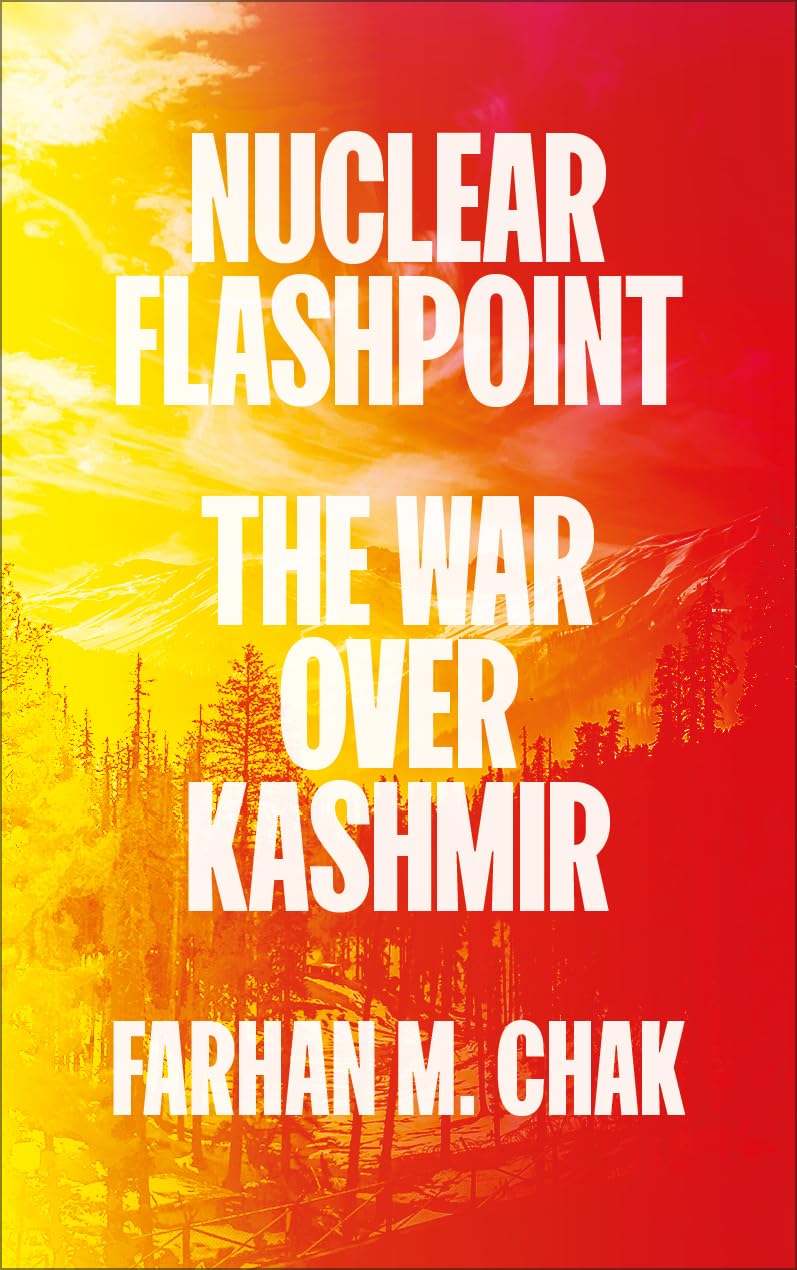
Contemporary Muslim World
Nuclear Flashpoint
The War Over Kashmir
Author(s): Farhan M. Chak
Reviewed by: Aadil Hussain Malik
Review
Reviewed by: Aadil Hussain Malik, Aligarh Muslim University, India
Published by: London: Pluto Press, 2023, 240pp, ISBN: 978 0 7453 4616 8
- - - - - - - - - - - - - - - - - - - - - - - - - - - - - - - - - - - - - - - - - - - -
Nuclear Flashpoint: The War Over Kashmir is a provocative and ambitious work that seeks to unravel the complex interplay of history, identity, and geopolitics of Kashmir, one of the most contentious regions of South Asia. Each chapter suggests a rigorous analysis of how the socio-political history of Kashmir intertwines with the forces of nationalism, religious ideology, and external political pressures, particularly from India, Pakistan, and China. Chak’s rigorous critique of colonial legacies, religious nationalism, and state-sponsored violence offers valuable insights, though some arguments would benefit from greater evidentiary support and a more balanced tone.
The book consists of nine chapters and, in the introductory chapter (pp.1-15), the author establishes the “Theatre of War” which addresses the pervasive and entrenched conflicts that have defined Kashmir’s history. The subheadings— ‘Contested Identities and British Raj,’ ‘Partition,’ and ‘Hindutva Fascism’—imply an exploration of how colonial rule and subsequent events, especially the Partition of India, contributed to shaping Kashmir’s identity. The introduction engages in a philosophical discourse on the nature of identity and its fluidity, particularly in colonized regions, where the native populace’s self-conception is often refracted through the ideological lenses imposed by imperial powers. The term ‘Hindutva Fascism’ is notable here, as it suggests that the author views the contemporary Hindutva movement as a form of ideological fascism. Chak argues that Hindutva, as an ideology, imposes a monolithic vision of Indian identity that excludes the diversity inherent in the subcontinent, particularly in Kashmir, where identity is multi-layered and complex (pp.7-11).