Contemporary Muslim World
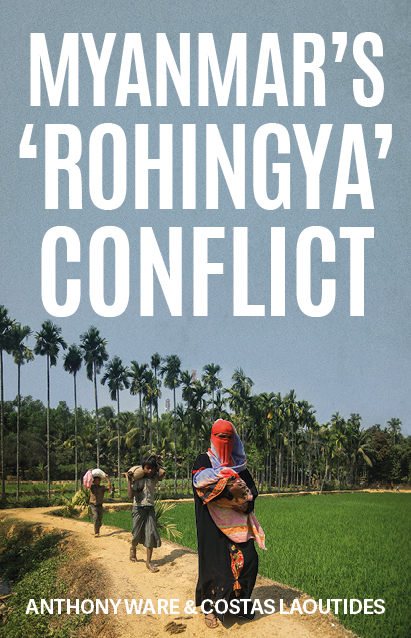
Myanmar’s ‘Rohingya’ Conflict
Author(s): Anthony Ware & Costas Laoutides
Reviewed by: Saad S. Khan, Quetta, Pakistan
Review
Publisher: Hurst & Co Publishers, London, 2018, 224pp. ISBN: 9781849049047.
The scarcity of academic resources about the ‘Rohingyas’, an ethnic minority following the Muslim faith in a Buddhist majority Myanmar, borders on non-existence. Notwithstanding that the community has been the most recent victim of genocide in the world. The term ‘genocide’ has been abused so massively in recent decades that states tend to label any widespread violence in a rival state as such, in order to gain political mileage against it. Hence, like “the boy who cried wolf” in Aesop’s eponymous story, hardly any international actor takes notice when a cry of genocide is raised. This is what exactly happened when genocide in Arakan state in north western Myanmar was actually taking place in the last decade. Renamed by the Myanmar’s military junta in 1989 as Rakhine, it has a 265 km long land boundary with Bangladesh (former East Pakistan) and a 400 km long coastline on the Bay of Bengal. Before the genocide, roughly 7% of Myanmar’s population was Muslim, four fifths of whom lived in Arakan/Rakhine state where the proportion of Muslims was slightly over a third, mainly of ‘Rohingya’ ethnic origin. The present work capably fills the vacuum in the study of the ‘Rohingya’ conflict.
In the past decade, the Rohingyas were killed, displaced or banished from their homes in Myanmar that was ethnically cleansed of its Muslim minority. And this crime took place under the watch of a government headed by a Nobel Peace laureate, Aung San Suu Kyi, and her National League for Democracy (NLD), most of whose leadership had themselves been victims of the same human rights violations at the hands of “Tatmadaw”, as the army is known in that country. For her own political calculation, Ms Kyi went far beyond turning a blind eye to the crimes against humanity by actively defending her trigger-happy army, appearing in person before the International Court of Justice at The Hague. One of the members of the Advisory Board on Ko Annan’s committee had to resign, saying Suu Kyi was “part of the problem”. She was to get the taste of her own medicine soon enough when the same army turned against her, toppled and detained her, and started carrying out crimes against humanity targeting her political support base in the majority Bamar community.