Islamic Thought and Sources
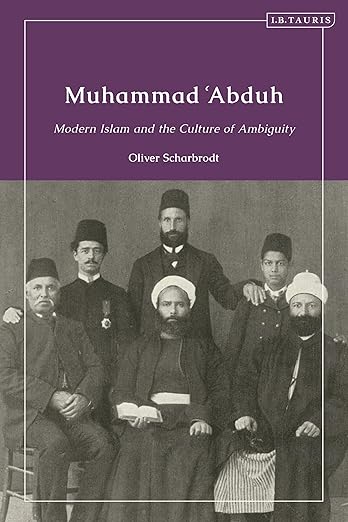
Muhammad ʿAbduh - Modern Islam and the Culture of Ambiguity
Author(s): Raymond William Baker
Reviewed by: Sajjad Rizvi
Review
Reviewed by: Sajjad Rizvi, University of Exeter, UK
Published by: London: IB Tauris/Bloomsbury Publishing, 2022, xi+262 pp. ISBN: 978-1838607302.
Muḥammad ʿAbduh (1849−1905) is certainly one of the most significant figures of modern Islam and, ever since Charles Adams’s and Malcolm Kerr’s classic monographs generations ago, has been associated along with his Iranian teacher Sayyid Jamāl al-Dīn al-Afghānī (or Asadābādī, 1838−1897) and his Syrian student Rashīd Riḍā (1865−1935) with the project of modernism, anti-colonial pan-Islamism, and Salafism arising from the colonial experience in Egypt. Elie Kedourie’s study of them tended to question their religious credentials – and certainly a number of their critics considered ʿAbduh to be an agnostic, crypto- Mason and much more. Albert Hourani famously described him as ‘eclectic’. More recently, Samira Haj discusses him in the context of traditionalism and locates him without a longer trajectory of Muslim revival and reform, while Mark Sedgwick’s Makers of the Muslim World volume gives us a brief survey of his positions. The contemporary Tunisian thinker Muḥammad Ḥaddād uses ʿAbduh to make a case for the secular and sees him as a modern secular public intellectual. The problem with most approaches is that they wish to reconcile what cannot be reconciled: ʿAbduh’s philosophical interests (he was one of the last Avicennians), his Ashʿarism, his neo-Muʿtazilism, his anti-colonial agitation, his loyalism to the British, his Salafism (and we often forget – and Lauzière and others have helpfully reminded us – that Salafism was a multivocal category in much of the 20th century even before its contemporary mutually deprecating schisms), his modernism, and his iconoclasm. In many ways, as a question of method, we need to drop this rather tired juxtaposition of a holistic and unified approach to a figure’s thought as opposed to developmentalism. Scharbrodt correctly surmises that the real issue is that we tend to read ʿAbduh through the prism of his student Rashīd Riḍā’s agenda and this leads to the distorted and polarised positions. Similarly, researchers tend to privilege his later works, especially the revised version of his Kitāb al- tawḥīd and Qurʾānic exegesis while neglecting the earlier works, sometimes – as if often done with an equally contested figure, al-Ghazālī, by critically re-appraising the authorship of some works; Muḥammad ʿImāra (1931−2000), the editor of ʿAbduh’s collected works, famously rejected the ascription of the early mystical and theological works to ʿAbduh on the grounds that they do not ‘sound’ like him and thus a major contribution of this volume is to engage these works and locate them within ʿAbduh’s early intellectual career especially based on Afghānī’s teachings.