Islam and the West
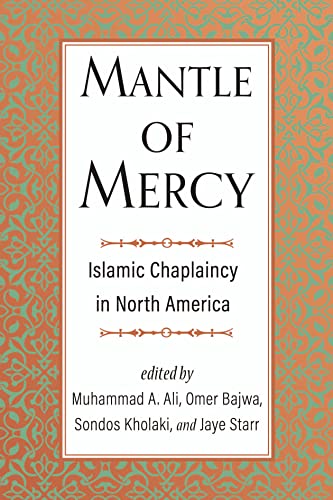
Mantle of Mercy:
Islamic Chaplaincy in North America
Author(s): Muhammad A. Ali & Omer Bajwa & Sondos Kholaki & Jaye Starr
Reviewed by: Ruqaiyah Hibell
Review
Publisher: Templeton Press, West Conshohocken, PA: 2022, 263pp. ISBN: 9781599475936.
In the UK there is a lack of academic material produced on Islamic chaplaincy. There are many possible reasons for this, namely, a dearth of research and input into documenting chaplaincy from a multitude of spheres and perspectives. Where there is research, it is usually focused on predictable topics and issues. British Muslim chaplains largely derive from Dar al-'ulum backgrounds who mainly herald from a Deobandi persuasion whose juristic tone and emphasis are not located within a tradition or emphasis that encourages academic research. Additionally, the cocooned nature of Dar al-'ulum education, and the strictures imposed frequently leave students adrift from contemporary communication and mainstream society. The implication being that emergent 'alims and 'alimahs may lack a rounded experience of life and this can impact their ability to understand and relate to diverse populations of people, although there are always students who emerge as exceptions to these norms and integrate extremely well to become successful chaplains.
The book under review is a welcome addition to the existing literature and research on Islamic forms of chaplaincy as it articulates a refreshing compilation of essays offering creative and original input, insight and energy that infuses existing perspectives on chaplaincy with luminous representations of service (khidmah). The editors have embraced the inclusion of discussion on complex issues that are often considered easier to ignore than to address, which is to their credit.
Muslim chaplaincy in the US differs in many aspects from that of the UK, in that it is more accessible and pronounced, embedded as it is into a wider range of institutions, and often favouring a generic approach to service delivery. It is notable how many African-American chaplains have been transformational in their approach to implanting Islamic chaplaincy within US Muslim communities and wider state institutions further supported by their scholarly output, which is quite a different situation to the UK where there are minimal chaplains from African or African-Caribbean heritages. Chaplains in the US context appear to promote a traditionalist approach to Islam, emphasising the centrality of the work of the heart and the essentiality of community to individual, local, national and global well-being and humanity at large.