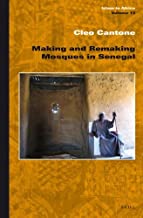
Contemporary Muslim World
Making and Remaking Mosques in Senegal
Author(s): Cleo Cantone
Reviewed by: Mohammed Hamdouni Alami, UC Berkeley, California
Review
In the academic subfield of Islamic Architectural History, attention to architectural typologies is a methodological pillar, but rarely does this attention go beyond formalist limitations. Now, Cleo Cantone’s book represents an exception, and offers its readers much more than its title suggests. It is an erudite book that ambitiously, and yet with humility, introduces the complex and multidimensional character of a religious typology in context. This is surely due to the double academic background of the author, as she was trained in both Ethnology and Art History. In contrast to much of the literature, Cantone’s work combines a well informed historical study of an architectural typology, Mosques in Senegal, and an insightful ethnography of use and appropriation of space in contemporary Mosques in that country.
After a synthetic Introduction the book opens with an excellent story (in the sense of Gombrich’s Story of Art) about the invention of the Sudanese Mosque typology. Here the author expands her analysis to a great part of Sub-Saharan Africa, including Mali whose mosques are among the greatest of this type and some of which unfortunately are currently reported by the international media as being the object of zealot destruction. Cleo Cantone’s analysis of the invention of the Sudanese mosque can help us understand this destructive fanaticism, for it aptly renders the complex intricacies of religious, social, political, and military factors implied in the making of this architectural typology. A majority of these mosques were indeed founded with missionary and military purpose to propagate particular religious Brotherhoods, Marabout, or Tariqah(s) which honour saints.