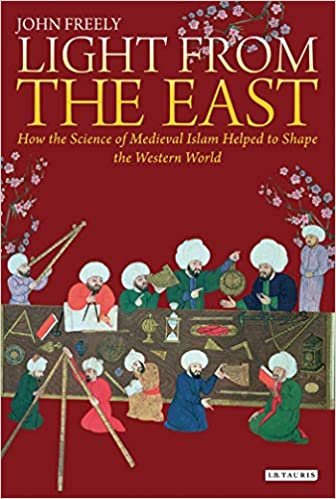
Light from the East
How the Science of Medieval Islam Helped to Shape the Western World
Author(s): John Freely
Reviewed by: Harfiyah Haleem, London, UK
Review
John Freely was born in 1926 in New York and joined the US navy at the age of 17, serving during World War II. With a PhD in Physics from New York University and post-doctoral studies in the History of Science in Oxford, he is now a professor of physics at the Bosphorus University in Istanbul. All this erudition shows in his thorough, systematic and detailed account of how Greek knowledge was gathered, along with knowledge from India, Persia, China and elsewhere, translated into Arabic and other languages, and used by the scholars of the Muslim world, of various faiths, to advance the sciences that were later passed on in Latin translations to Europe and beyond.
Freely’s first chapter is an account of what the Greeks brought to science, and how it was disseminated, how anti-pagan Christians destroyed the great library at Alexandria in Egypt, and how the Greek scholars fled east to Byzantium, Persia and Central Asia, taking their knowledge with them. This chapter is useful in that it states briefly just what their contribution was in terms of astronomy, astrology, philosophy, maths, medicine, ethics, politics and so on. It is clear throughout the book that the works of Aristotle, Plato, Pythagoras, Plotinus, Ptolemy, Euclid, Galen and others formed the basis of many of the works written in the Muslim world, and that scholars there disputed their findings, made their own suggestions, observations, experiments, augmenting and correcting the Greek treatises they were reading, sometimes backing one Greek view against another.