Islamic Thought and Sources
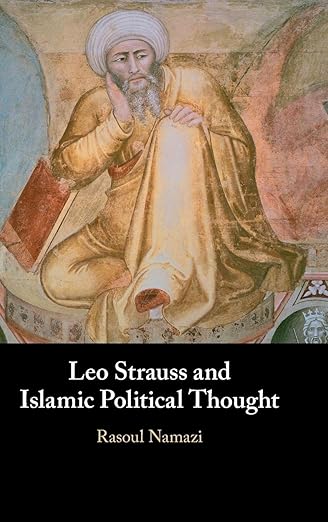
Leo Strauss and Islamic Political Thought
Author(s): Rasoul Namazi
Reviewed by: S Parvez Manzoor
Review
Reviewed by: S Parvez Manzoor – Stockholm, Sweden
Published by: Cambridge, UK: Cambridge University Press, 2022, 290pp. ISBN: 978-1009098700.
Though most readers of this journal may not perhaps be acquainted with Leo Strauss’s remarkable albeit highly idiosyncratic contribution to the study of political philosophy, he was indeed a veritable phenomenon, an academic one during his lifetime and a political one after his death. Indeed, it is a wonder how this German émigré with his native accent still showing, an erudite and recondite interpreter of ancient philosophy and medieval esoteric texts, years after his death, acquired such explosive notoriety that his legacy still haunts us in the Culture Wars of our times. And yet for all scholarly effort to elucidate his thought, for all polemical zeal to castigate his politics, for all the promise of his ‘intellectual biography’, the man himself and his message remain frustratingly out of reach. Surprisingly, not a single full-length biography has come out in print, despite the fact that the main landmarks of his life are well-known, and all his writings including private correspondence have been diligently collected and preserved.
Whether one accepts or ignores the claim that Leo Strauss’s biography is crucial to understanding both the man and his work, the predicament about his thought, his teaching, his esoteric and exoteric writings, his political belonging, his moral domicile, indeed his faith and whether he possessed any ethos at all, remains. To some, his Prussian birth, Jewish upbringing, and German higher education at Marburg and Freiberg provide inestimable help in understanding his philosophical writings. Indeed, for one of his harshest denigrators, despite all his connection to the American society, culture and academy, Strauss remains a “German Stranger” (William H. F. Altman: The German Stranger: Leo Strauss and National Socialism, Lexington Books, 2011). Altman explains: “The key to understanding Strauss for me is to recognize that he was first and foremost a