Islamic Thought and Sources
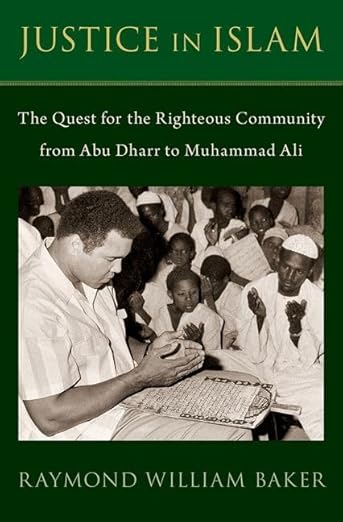
Justice in Islam
The Quest for the Righteous Community from Abu Dharr to Muhammad Ali
Author(s): Raymond William Baker
Reviewed by: Usman Bugaje
Review
Reviewed by: Usman Bugaje – Kaduna, Nigeria
Published by: Oxford, Oxford University Press, 2022, 288pp. ISBN: 978-0197624975.
This, by any standard, is an interesting book. There is a lot of useful analysis on the nine prominent scholars of Islam who spent their entire lives in a struggle to live Islam and keep its spirit alive. But this is not what the book stands out for, as these can be gleaned out from numerous sources. Rather, it stands out for the choice of the theme which permeates through the life and times of these personalities and the depth and breadth of analysis which throws a new light on the contemporary Islamic struggle in Muslims lands. The choice of justice as a theme that runs through the lives of the figures of struggle, in the last one hundred years of Islam, shows the author’s deeper understanding of the message of Islam and his unfettered access to the deep recesses of Islamic sources, primarily the Qurʾān and Sunnah. Coming from the West, he has shown both sterling scholarship and courage in expounding on the unity of all God’s Prophets from Adam to Muḥammad (blessings and peace be upon them), particularly in grasping the special position which Muslims accord Jesus, which he calls here the Muslim Jesus, a Prophet to be revered and not a God to be worshiped. And his expertise in international politics has certainly helped him to see through Western motives and propaganda.
The author Raymond Baker is Professor Emeritus of International Politics, Trinity College, Hartford, CT and Board Director, International Council for Middle East Studies, Washington D.C, author of many books and scholarly articles, including Islam Without Fear (2004) and One Islam, Many Muslims Worlds (2015). His inspiration appears to be the Islamic concept of justice, especially how Islam sees itself as a continuum with all the Prophets including and particularly Jesus. This understanding seems to have come from the depth of his study of the numerous works of prominent Muslim scholars in the last 100 years or so. He was struck by the Prophet Muḥammad’s statement, as reported by Ali Shariati, that “the blue sky never cast a shadow upon, and the dark earth never saw a more truthful man than Abū Dharr” and that “the modesty and piety of Abū Dharr resembles that of Jesus son of Mary.” This authoritative linkage, as he calls it, of Abū Dharr, the symbol of justice and the Muslim Prophet Jesus crystalizes Islam’s understanding of justice, which is at once worldly and spiritual. He finds it intriguing that while Muslims accept Jesus comfortably as an integral component of their belief and practice, “Christian culture makes seeing Jesus as an Islamic figure all but impossible” (p.3).