Islamic Thought and Sources
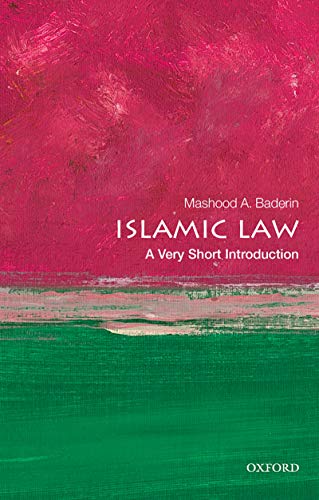
Islamic Law
A Very Short Introduction
Author(s): Mashood A. Baderin (Ed.)
Reviewed by: Zahed Fettah
Review
Published by: Oxford University Press, Oxford, 2021, 176pp. ISBN: 9780199665594.
Discussions on Islamic law today are often referred to by many, mainly Muslims, as a historical utopia, while others speak of it as a historical reality and even a potential threat to modern society. Nonetheless, outside of the personal sphere, Islamic law appears to be a mere theoretical discussion amongst academics and writers. The author of the book under review, does an excellent job in merging the fiqh (law) that is found in the classical and modern legal works with the law that is applied in today’s world with all the unprecedented changes that have occurred in the last few centuries. His aim is to introduce the nature of Islamic law, the legal theory upon which the law is built, and also to shed light on some of its modern applications in Muslim countries.
It is generally accepted by Muslims that Islamic law represents the law that is divinely revealed to the final Prophet of Islam, Muhammad (blessings and peace be upon him). This is true for much of the law, since the main sources of Islamic law are the divinely revealed scripture, the Qur’an, and the divinely inspired prophetic application, known as the Sunnah. However, Baderin points out on a number of occasions that this does not include all the law. He distinguishes between the divinely revealed Shariah law that is directly from God and the substantive law (fiqh), or ‘branches of the law’, that is extrapolated from the legal sources through human effort and the reasoning of the expert jurists of Islam. This makes up a large part, if not most, of Islamic law. Naturally this means that the possibility of error is present in such a vast area of Islamic law. This of course also means that legal scholars will disagree on many rulings as a result of differences in interpretation. This is why the author was critical of describing Islamic law as ‘the law of God’, since such a generic description does not take into account the branches of the law which are the result of human reasoning which can be, sometimes, plainly wrong...