Islamic Economics and Finance
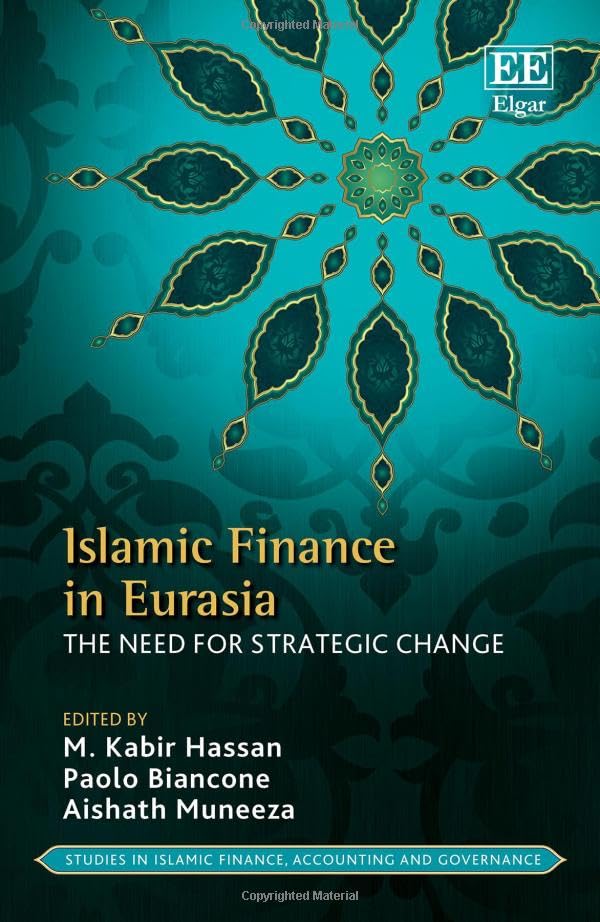
Islamic Finance in Eurasia
The Need for Strategic Change
Author(s): M. Kabir Hassan & Paolo Biancone & Aishath Muneeza
Reviewed by: Toseef Azid
Review
Reviewed by: Toseef Azid, Qassim University, Saudi Arabia
Published by: Cheltenham, UK: Edward Elgar Publishing Limited, 2024, 340pp. ISBN: 978-103538699.
- - - - - - - - - - - - - - - - - - - - - - - - - - - - - - - - - - - - - - - - - - - -
Within the world of economics and finance, there has been ongoing research and discussion on the concepts of moral and ethical values, in particular within the field of Islamic economics and finance. Moreover, a keen interest in the above two fields is also observed in the developed countries such as USA and Western Europe. It is also a well-known fact that a growing discussion on these topics has changed the dimensions of the financial market. Currently academicians, experts and policymakers are widening their outlook and including theses aspects in their analysis and giving less attention to those concepts of economics and finance, which in their views are abstract ones. Likewise, social scientists are also focusing currently on morality and ethical values through the lens of well-being metrics.
However, research in Islamic economics and finance analyses things in a different way, i.e. researchers in conventional economics and finance divide their analysis into two dimensions in that the emphasis is on the quality of life and inner satisfaction. In the context of Islamic finance, the focus is on both this worldly life and the hereafter. This is because reward in the hereafter is a significant factor which changes the behaviour of the believers regarding their economic needs. The literature of Islamic economics and finance tries to convince the readers that well-being is not only dependent on income, education and healthcare but also on the universal set of morals and ethics, i.e. virtue, honesty, trust, truthfulness, etc. Due to these above mentioned moral values, the concept of well-being is different among the believers and non-believers. It is also emphasized in the literature of Islamic economics and finance that moral and ethical values are transferred from one generation to another, i.e. intergenerational transformation, and therefore it is a dynamic process.