Islamic Thought and Sources
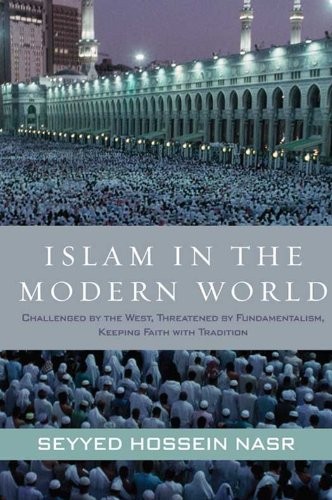
Islam in the Modern World
Challenged by the West, Threatened by Fundamentalism, Keeping Faith with Tradition
Author(s): Seyyed Hossein Nasr
Reviewed by: Imtiyaz Yusuf, Assumption University, Bankok, Thailand
Review
The book under review comprises a prologue, three parts, a postscript and four appendices. The first part of the book discusses contested issues in contemporary Islam, the second part contrasts traditional Islam with modernism, and the third part discusses tensions between tradition, modernism and fundamentalism in the areas of education, philosophy, science, art and architecture. Professor Nasr gives an authoritative statement on what, according to him, constitutes ‘traditional Islam’, a term which appears often in most of his writings. Traditional Islam in Professor Nasr’s definition comprises the Qur’an, Hadith, Shari[ah, Tariqah, the Muslim hermeneutical tradition from Hasan al-Basri, Imam Ja[far al-Sadiq, classical Muslim philosophers and mystics such as Ibn Sina, Ibn [Arabi, Suhrawardi, Mir Damad, Mulla Sadra and Muslim perennial philosophers such as René Guénon, Frithjof Schuon, Titus Burckhardt, Martin Lings and Nasr himself. It also includes belief in Ithna [Ashari messianism, not that of revolutionary Shi[ahs such as Ali Shariati, Ayatullahs Khomeini, Taleghani, Montezeri and Mutahhari. Nasr respects Ayatullah Khomeini’s scholarship but not political Khomeinism.
The hallmark of traditional Islam is its emphasis on esoteric hermeneutics which is to be distinguished from what Nasr classifies as the exoteric, literal, historical interpretation of Islamic sources adopted by Muslim modernists and fundamentalists which include: Muhammad [Abduh, Abu’l A[la Mawdudi and Sayyid Qutb, including the Muslim Brotherhood in the Middle East, Jama[at-e-Islami in the Indo-Pak subcontinent, Wahhabism in Saudi Arabia, the Nursi movement in Turkey, Khomeinism in Iran and the Muhammadiyyah in Indonesia. According to Nasr, Islamic modernism, fundamentalism and Salafism are allied movements which have either dislocated or ruptured the Islamic tradition by causing discord in the areas of Islamic spirituality, ethics, thought, education, political tradition and approaches to philosophy, sciences, art and architecture. He is also not happy with the modernized and technological status of the developing Muslim world from Turkey, Iran, Black Africa to Malaysia and Mindanao. While being critical of political Islam as the cause behind the rise of fundamentalism in the Muslim world, Nasr makes no comments about secular fundamentalism of the Muslim and non-Muslim types which equally threatens spirituality.