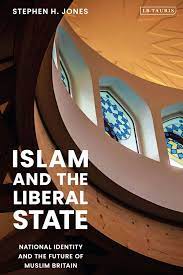
Islam and the West
ISLAM AND THE LIBERAL STATE
NATIONAL IDENTITY AND THE FUTURE OF MUSLIM BRITAIN
Author(s): Stephen H. Jones
Reviewed by: Ricky Bains, Markfield Institute of Higher Education, UK
Review
Stephen Jones has been researching and teaching as a sociologist of religion for over fifteen years. His scholarly engagements have also uniquely led him to work for organisations rooted in local Muslim communities, as well as holding the position of General Secretary of the Muslims in Britain Research Network. In this book, Jones challenges the view that liberalism and Islamic traditions are incompatible, going further to state that the meaningful incorporation of Muslim minorities would lead to democratic renewal. He seeks to provide an accurate picture of the character of British Islam and how it relates to the liberal state.
Writing in the era of Brexit and Trump, Jones sets forth with what he believes is a convincing and empirically substantiated argument. Namely, there has been a remaking of British Islam’s institutional landscape which has been moulded by a dominant trend of building a deeply rooted British Islam. Contrary to provocative, oft-repeated media talking points, Jones carefully demonstrates how institutional change has been and continues to occur ‘under the radar’ (p. 2).
The three types of institution investigated to illustrate the central thesis are: educational, legal and political. Jones persuasively demonstrates that Islam in Britain has reoriented itself around British public and institutional norms. Before diving into each one of these arenas, there is a rich introduction which sets the scene and carefully defines terms. Jones also provides context for his argument by demonstrating that British Muslims show a ‘stronger identification with Britishness’ (p. 4), academia devalues scholarship on institutional change which often remains ‘in the margins’ (p. 6), and there is a general problem of ‘selective literacy’ (p. 9) in the UK when it comes to the fundamental tenants of Islam. Jones wishes to focus attention on questions of religious interpretation, institutionalisation, and authority in his aim to ‘understand the transmission and transmutation of Islamic traditions in the UK’ (p. 11).