Short Reviews
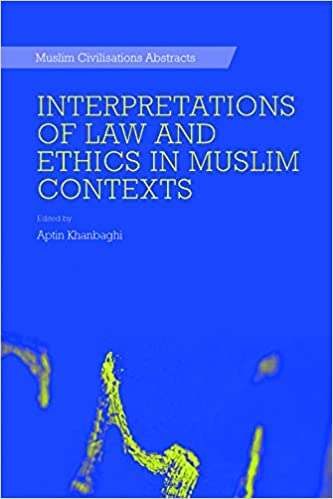
Interpretations of Law and Ethics in Muslim Contexts
Muslim Civilisation Abstracts
Author(s): Aptin Khanbaghi
Reviewed by: Murad Wilfried Hofmann, Bonn, Germany
Review
Written by a researcher of Aga Khan University in London, this volume consists of 218 annotated bibliographic abstracts of scholarly Muslim publications on law and ethics presented in separate sections in English, Turkish, and Arabic. The abstracts are from texts published from the early nineteenth century to 2009 in Arabic, Indonesian, Malayan, Persian, Russian, and Tajiki. The abstracts are descriptive rather than critical, each running to about half a page. The legal systems in Muslim states did not result only from particular expressions of Islam but also from the residue of ancient local traditions and the influence of pre-eminent European legal concepts and practices. Consequently, the rather divided Muslim world always lacked legal uniformity – a fact that renders certain abstractions like the idea of clashing civilizations meaningless. Although law and ethics normally feed on each other, the ethical purposes of law are sometimes eclipsed by secular legislation, as in Turkey, or by culturally syncretic legal traditions, as in Indonesia. As a result, Muslim countries like Turkey, Iran, Indonesia and Morocco are miles apart from each other not only in sectarian terms but legally as well. Most of the authors selected for abstraction are known locally only, Yusuf al-Qaradawi (Fiqh al-Zakat, 1991) and Mahmud Hamdi Zaqzuq (al-Insan wa alQiyam fi al-Tasawwur al-Islami, 2003) being the rare exceptions.