Spirituality and Theology
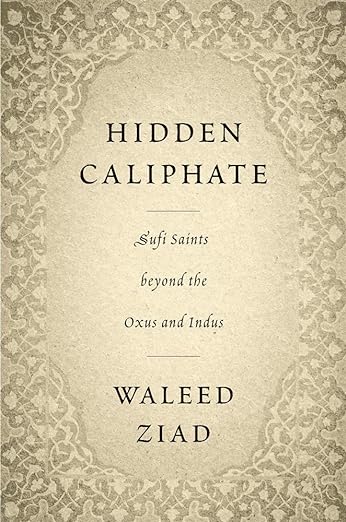
Hidden Caliphate
Sufi Saints beyond the Oxus and Indus
Author(s): Waleed Zia
Reviewed by: Abdullah Drury
Review
Reviewed by: Abdullah Drury – University of Waikato, New Zealand
Published by: Cambridge, Massachusetts:, Harvard University Press, 2021, 354pp. ISBN: 978-0674248816.
This book is so far ahead of the curve in this field of study that it is in a different time zone.
In a vigorous, excoriating rebuttal of current ideological myths about the era and the land, and the impact of the Europeans on central Asia and the Indian subcontinent, Waleed Ziad demonstrates how evidence has been manipulated in the interest of political activists whose comprehension of the past is corrupted by their obsession with issues of today. The Hidden Caliphate presents a fresh perspective on Islamic sovereignty and bureaucracy by steering away from traditional narratives centred on kings and queens, battles and dates, court intrigues, colonial and imperial polities and influences, and the conventional story of the “Great Game” in central Asia. His work sheds light on the complex role of the polity of Afghanistan in upholding a vast but loose network of scholarly and economic interactions, and provides a useful perspective into “the religious network that made [private] journey possible in a time of political fragmentation” (p.2). Drawing from extensive fieldwork spanning Afghanistan, Pakistan and Uzbekistan – and conducted in madrasas, Sufi retreats, private libraries, and archives – this tome uncovers the enduring impact of Mujaddidī reform and resurgence and the manner in which knowledge systems were processed and transported.
The Naqshabandī-Mujaddidī order here can be said to have started with Shaykh Aḥmad Sirhindī (d.1624), an Indian Sufi, but intellectually these ideas could be traced back to Ibn ʿArabī (1165-1140) of Andalusia. The legacy of Sirhindī, the adherents of this Sufi order, advocated an ontology that encapsulated scholastic and social welfare functions that could be described both as bāṭinī (secret, hidden or esoteric) and ẓāhirī (exoteric, manifest) simultaneously. Over time, a number of Islamic sages and poets spread out geographically from the town of Sirhind in India creating “a vast, intricate network of scholar-mystics known as the Naqshabandi- Mujaddidi” (p.2). These exiled and émigré disciples welded together Arabic, Persian and local vernacular literary traditions with popular ascetic and spiritual activities, and acts of virtuosity and commercial acumen, into an urban scholastic dominion that was simultaneously hybrid and elastic but also unified and functional.