Islamic Thought and Sources
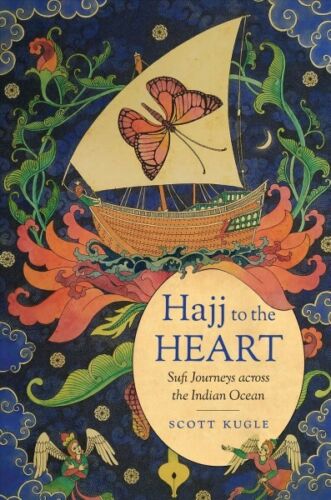
Hajj to the Heart:
Sufi Journeys across the Indian Ocean
Author(s): Scott Kugle
Reviewed by: Muzaffar Iqbal
Review
Publisher: University of North Carolina Press, The Chapel Hill, N.C.: 2021, 324pp. ISBN: 9781469665313.
This new book by Scott Kugle, Professor of South Asian and Islamic Studies at Emory University, is both a continuation and a departure from his previous publications most of which were intensely focused on issues of gender and sexuality (Sufis and Saints’ Bodies: Mysticism, Corporeality and Sacred Power in Islamic Culture, UNC Press, 2007, Homosexuality in Islam: Critical Reflection on Gay, Lesbian and Transgender Muslims, Oneworld Publications, 2010, Living Out Islam: Voices of Gay, Lesbian, and Transgender Muslims, NYU Press, 2013, When Sun Meets Moon: Gender, Eros, and Ecstasy in Urdu Poetry, University of North Carolina Press, 2016).
Hajj to the Heart continues his interest in Islamic mysticism but it departs from his obsession with sexuality. Another difference to note is the absence of his Muslim name (Siraj al-Haqq, lit. the “light of Truth”) as the author of the book. This personal choice was previously used to promote his unauthentic views on same sex relationships. He presented himself as a progressive Muslim voice finding theological grounds for the lewdness which no people ever committed before (Qur’an 29: 28). Kugle had argued that there is nothing in the Qur’an that condemns homosexuality, despite the fact that the people mentioned in the Qur’an were utterly destroyed by the blast which overtook them before morning, and whose city was turned upside down, and received Divine punishment of a very special kind (Qur’an 15: 73). He had sought to “liberate” the Qur’an (Chapter 2, Liberating the Qur’an: Islamic Scripture”). In order to achieve his objective, he used the same worn-out methodology that has been employed by many others in recent times: make the interpretation of the Qur’an a subjective matter, bound by time, place, and orientation of the interpreter and discredit Hadith as an authentic source.