Islamic Economics and Finance
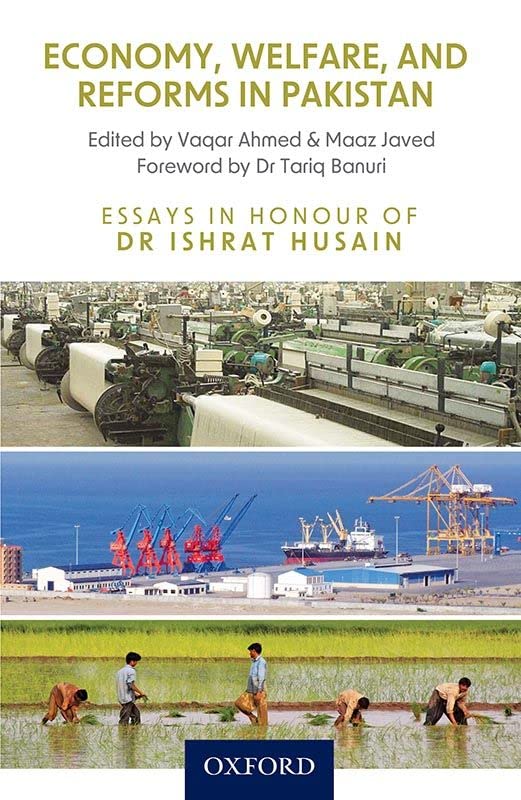
Economy, Welfare, And Reforms in Pakistan
Essays in Honor of Dr Ishrat Husain
Author(s): Vaqar Ahmed & Maaz Javed
Reviewed by: Toseef Azid
Review
Reviewed by: Toseef Azid, Qassim University, Saudi Arabia
Published by: Karachi: Oxford University Press, 2022, 307pp. ISBN: 978-0190708818.
Edited by: Vaqar Ahmed and Maaz Javed.
- - - - - - - - - - - - - - - - - - - - - - - - - - - - - - - - - - - - - - - - - - - -
Economy like the human body has different organs with specific functions and, furthermore, every organ has different clinical problems. Practitioners prescribe specific treatments for specific clinical problems. It is quite normal that different school of thoughts (e.g. classical, Keynesian, neoclassical, monetarist, institutionalist, etc.) developed their general approaches with their specific assumptions and went on to search for solutions for different economic issues within the contours of these suggested approaches. There are, however, some economists who have developed alternative approaches to these, such as Amartiya Sen (Capability Approach) and Mahboob ul Haq (Human Development Index). Rare are those economists who do not follow the abovementioned approaches and these prescribe specific treatments for specific problems. Sachs calls these ‘clinical economists’ because they behave like health practitioners. Among the economists who have made a significant contribution to economics and economic thinking is Dr. Ishrat Husain.
The volume under review is itself a good contribution, the chapters in the five parts of the book are well written and the foreword by Banuri and introduction by Suleri, in honour of Dr Ishrat Husain, are outstanding. In appreciation of Dr Ishrat Husain’s efforts and contribution in the field of economics, Banuri writes: “It is possible to discern some recurring patterns, all of which are visible in Hussain’s contributions. These include, first, an upcoming commitment to poverty eradication. Second, to compensate for theoretical certitudes, there is focus on institutional strengthening and robust feedback mechanism (to enable policy to keep track of changing realities). Third, the mobilization of political commitment is recognized as a prerequisite for the sustained pursuit of the policy objectives” (p.ix). In the introduction, Suleri presents Dr. Husain through his work and policies which he suggested for a progressive, humanitarian and exploitation free society. As a clinical economist, not only did he diagnosed economic problems but he also suggested specific prescriptions. Through his reforms, he tried to liberate the layman from a small and exclusive elite. Suleri highlights those areas of Husain’s engagements that he witnessed directly when they worked together. There is an also appreciation for his role in Liberia, Sierra Leone and Ghana where he prepared the first structural adjustment loan (SAL) and it was for the support of policy reforms instead of traditional investment projects. Then in Nigeria, Husain’s contribution was excellent when he was able to implement his reforms with the help of SAL.