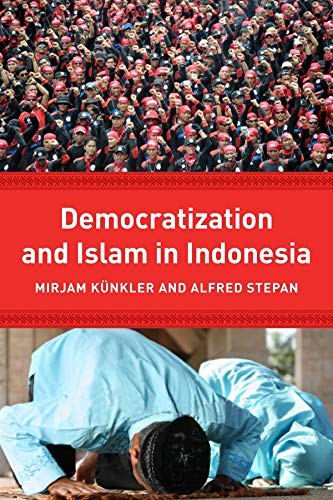
Contemporary Muslim World
Democracy and Islam in Indonesia
Author(s): Mirjam Künkler & Alfred Stepan
Reviewed by: Tauseef Ahmad Parray, Islamic Studies, Higher Education Department, Jammu and Kashmir
Review
Indonesia’s transition to democracy began with the overthrow of the Suharto regime in 1998 and, since then, most observers are of the opinion that this country has gone through a “democratization miracle”. The edited volume under review is a collection of nine essays, divided into four parts, written by eleven leading academicians and analysts. It explores various questions relating to Indonesia’s democratic transition and the consolidation of democracy as well as the interplay of religion and politics in this country. (p. 4) The book takes into consideration the three dimensions of democratic consolidation: Attitudes, Behaviours, and Constitutionalism. The attitudinal dimension is dealt with in chapters 3 and 4, the behavioural in chapters 5 to 7, and the constitutional in chapters 8 and 9. These chapters are preceded by an introductory part which consists of chapters 1 and 2. In the introduction, the two editors set a theoretical perspective for Indonesia’s transition to democracy and its consolidation, the challenges faced and achievements in this process as well as the volume’s structure. In chapter 2, R. William Liddle and Saiful Mujani offer a conceptual and empirical examination of the end of authoritarianism in Indonesia, the beginning of the democratic transition, and the possibilities of democratic consolidation. They outline three dimensions of democratic consolidation which constitute the same basis for the framework used by the editors in their division and selection of topics covered in the volume. Liddle and Mujani argue that although democratic consolidation, in all its three dimensions, has been achieved in Indonesia, this “has not been complete or unproblematic”. (p. 25)