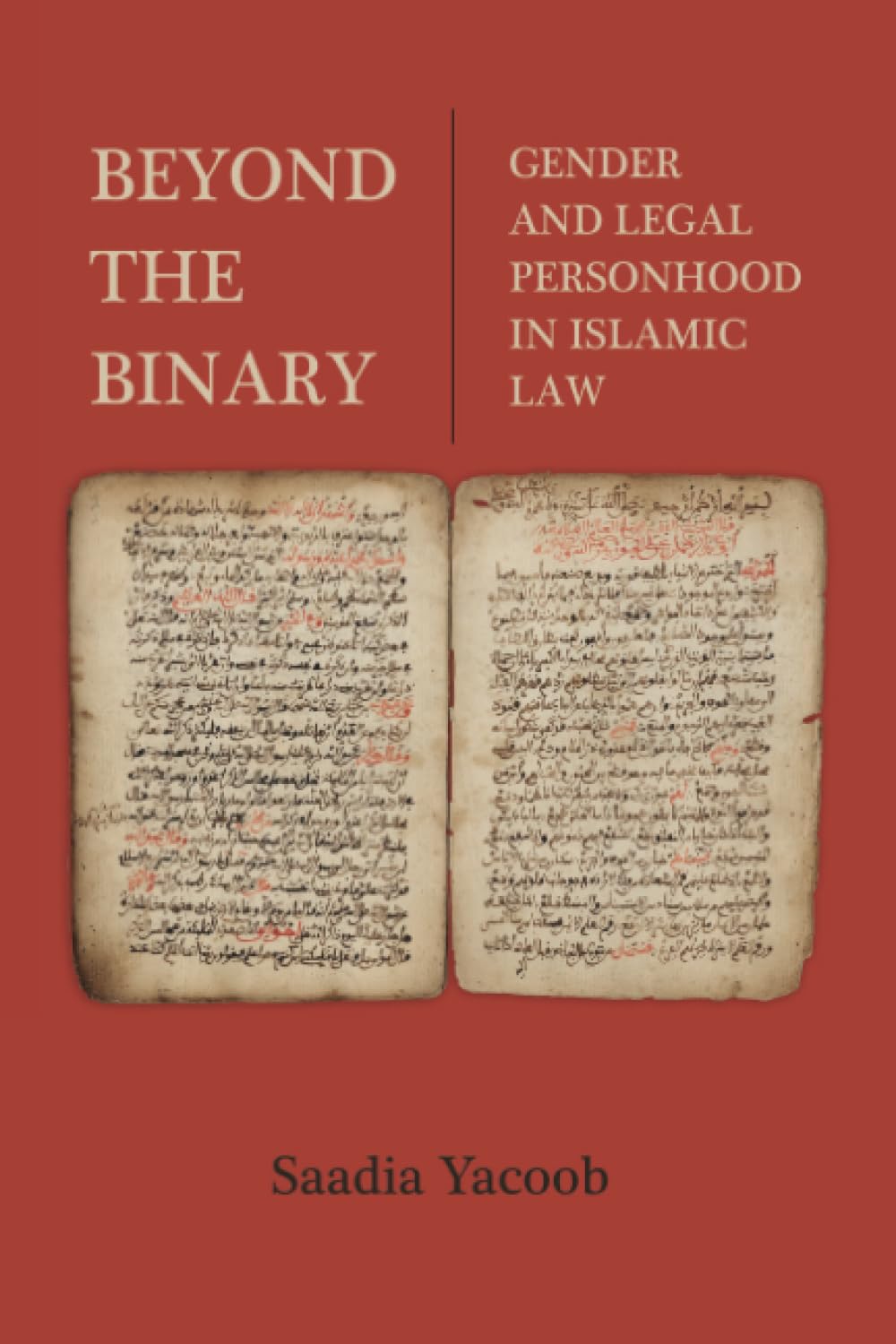
Islamic Thought and Sources
Beyond the Binary
Gender and Legal Personhood in Islamic Law
Author(s): Saadia Yacoob
Reviewed by: Anis Ahmad
Review
Reviewed by: Anis Ahmad, Riphah International University, Pakistan
Published by: Oakland, CA: University of California Press, 2024, 162pp. ISBN: 978-052039806.
- - - - - - - - - - - - - - - - - - - - - - - - - - - - - - - - - - - - - - - - - - - -
The contemporary discourse on Islam, Muslim and the Sharīʿah often refers to the existence of gender discrimination, rather exploitation, in Islam. One common observation is that the covering of the head with a scarf or wearing a jilbāb are imposed by men on their women. Muslim women should therefore be liberated from this oppression. Those who make such sweeping generalization fail to notice thousands of Muslim women and young girls who are born in the liberal societies of the West – in France, Germany, the UK and other European countries – who were the hijab purely out of their free will, and quite often against the will of their parents or husbands. They never feel depressed because of the way they dress nor do they feel disadvantaged as Muslim women due to their choices.
The contemporary discourse on so-called “inclusiveness”, a euphemism for accepting abnormality, has led to a serious disturbance of social norms, even in the liberal West. Recently, there was an uproar in Capitol Hill when a transgender person tried to use a washroom designated for women. The conceptual shift in the meaning of even simple and common words has created a confusion in ways of communication. Intellectuals need now to redefine the meanings and implications of several common words.