Contemporary Muslim World
A Leadership Odyssey:
Muslim Separatism and the Achievement of the Separate State of Pakistan
Author(s): Sikandar Hayat
Reviewed by: Iftikhar H. Malik, Bath Spa University
Review
Publisher: Oxford University Press, Karachi: 2021, xii+327pp. ISBN: 9789697340132.
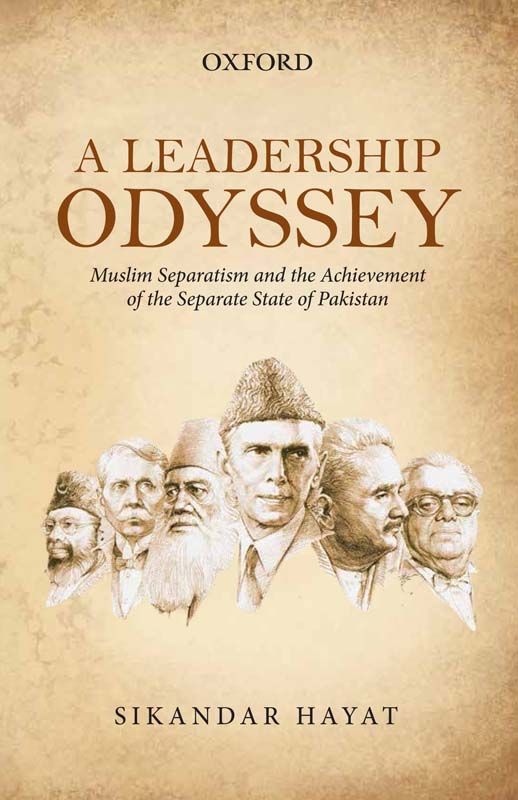
“This leadership odyssey made it possible for Muslim separatism to grow and develop into a separatist political movement, eventually the Pakistan Movement which, led by M.A. Jinnah, culminated in the achievement of the separate state of Pakistan. Muslim separatism and its persistent pursuit had finally come to fruition.” This is how Sikandar Hayat, Pakistani historian and a biographer of M.A. Jinnah (1876–1948), concludes his volume, which in itself focuses on seven preeminent Muslim leaders in the Indian subcontinent who, according to him, were variably the main proponents of a Muslim identity, separate and distinct from other South Asian communities, especially the Hindus. Hayat posits India traditionally to be a polyglot where the parallel existence of several religious and cultural communities over successive centuries set the milieu for the eventual parting of ways, generally known as the Partition. Hayat is unreservedly attuned to the instrumentalist interpretation of identity formation, instead of its primordialist interpretation, and despite religion – largely Islam and Hinduism in this case – he finds culture and politics as two main denominators of distinctive pathways. Culturally defined Muslimness, though moored in Islamic practices, finally graduated into a political creed, which was pioneered more than anybody else by Sir Syed Ahmad Khan (1817–1898), an institution-builder, a reformer and untiring modernist, all in the service of his fellow Muslims in a growingly competitive subcontinent. Hayat is sensitive to the exceptionalisation of Indian Muslims under the Raj that reproaches the former for often pursuing armed resistance including the lion’s share in the Rebellion of 1857. Khan, a witness to the destruction of Delhi and the late-Mughal elite in northern India, cautioned both the British and Muslims against a continued politics of polarity and, instead, through modern education, rationalism and with Muslims joining the public sector, he advised his community in particular to make a fresh and essentially different start. His Aligarh campaign turned into the firstever modern university across the Muslim world whereas Khan’s extensive writings and foundational work helped several future Muslim leaders further his strand of thinking which was initially and essentially apolitical in its intent and content.